This article was originally published in Italian on Games969.com in 2014.
Punk rock, often shortened to punk, is a genre of rock music that developed between 1976 and 1979 from earlier forms of garage rock, today known as proto-punk.
That’s how the Italian Wikipedia opens its definition of Punk Rock, seen as both a musical genre and an artistic movement born out of garage rock in the late seventies. If we were to define the same concept within the world of video games, we could easily point to the work of Suda51—or to the latest creation by Insomniac Games, the studio celebrated worldwide for series like Spyro the Dragon and Ratchet & Clank. Although the team’s past attempts at shooters were far from flawless (Resistance, for Sony’s PS3, being another iteration of their creative flair), today we can confidently call Sunset Overdrive one of the most promising new IPs in the modern gaming scene.
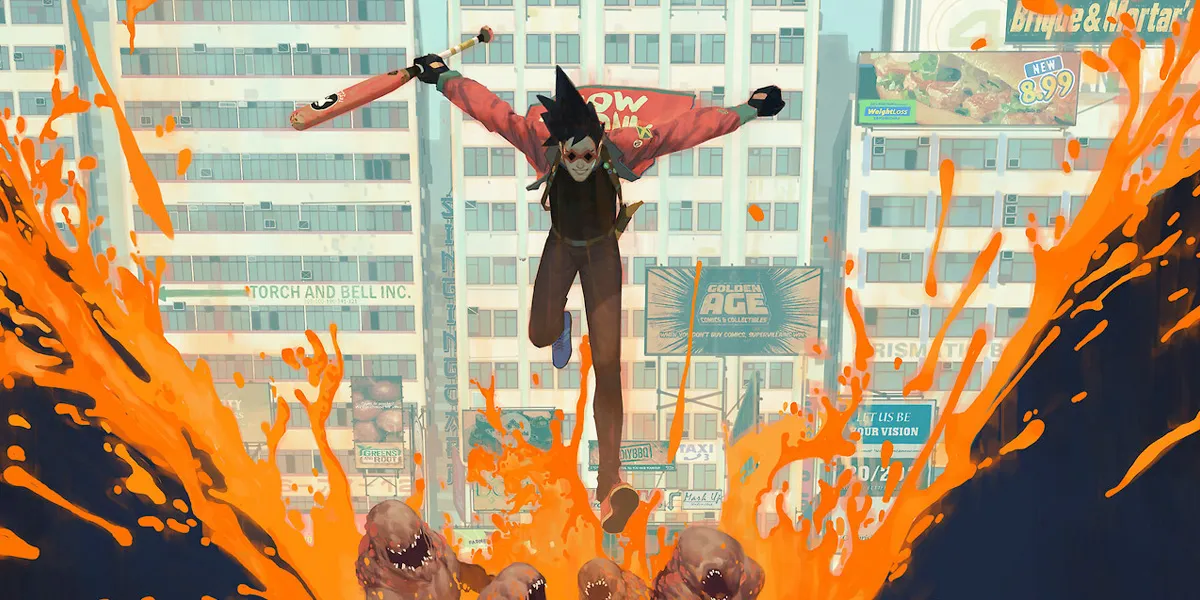
The concept is simple: take all those elements that the gaming industry has been shoving down our digital throats in recent years—flashy ads, bombastic trailers with six-figure budgets, and over-the-top marketing—and mix them with an acidic aesthetic, a self-aware and irreverent script, and a gameplay system that doesn’t care about realism or being “next gen.” It just wants to have fun… by having fun. If we were to find out that much of what fills the cityscape of Sunset Overdrive exists purely for the artistic or personal satisfaction of the developers, it wouldn’t be surprising in the least. This Xbox One exclusive, which accompanied Halo: The Master Chief Collection during the console’s winter season, is a true Ode to Metropolitan Chaos—a “AAA” title that somehow manages to ooze the passion of everyone who worked on it.
From the very first minutes, it’s clear that this is an authorial work that screams, “Did you really think all games were the same?”—middle finger up, tongue out. But what exactly should players expect once they open that bright green case?
The citizens of Sunset City have mutated after consuming a mysterious energy drink mass-produced and distributed throughout the metropolis. It’s up to the hero—or heroine, depending on your choice—to uncover the truth behind this sudden apocalypse, all while living through a wild, absurd adventure alongside a cast of over-the-top characters straight out of a teenage or post-apocalyptic comedy. The irreverent script and direction often recall the style of a comic-book movie, reminiscent of Scott Pilgrim vs. The World and the works of British filmmaker Edgar Wright. Your character doesn’t even need a name—their sarcastic one-liners are enough to define their personality without resorting to forced melodrama or Hollywood-style cinematic excess.
The narrative of Sunset Overdrive constantly references pop culture while delivering a biting critique of the clichés that dominate modern game writing (the game’s hilarious trailer released months before launch is a perfect example). The fourth wall is broken repeatedly to mock the very conventions of video game storytelling, and suspension of disbelief isn’t even on the table. Everything about Insomniac’s game seems to assert its creative and intellectual independence, even at the risk of alienating those who see video games only as stepping stones toward cinematic language.
Structured like a classic open-world game set in a vibrant city, Sunset Overdrive lets players roam freely through a gleaming, color-soaked metropolis built from grind rails, rooftops, and bounce pads that defy both logic and gravity. These acrobatic stunts aren’t just for show: pulling off stylish “tricks” between enemy kills fills a combo meter in the corner of the screen, rewarding players with higher scores and greater rewards. The more creative your carnage—fueled by a collection of outrageous weapons seemingly designed by Acme Industries—the more bonuses you’ll rack up.
What truly works in Insomniac’s gameplay design is the freedom it gives to player imagination. There’s no “right” way to play and no weapon that outshines all others, even if enemies have specific weaknesses. Sunset Overdrive encourages experimentation, rewarding players for whatever they’re good at—and whatever they enjoy doing most. Character and weapon progression are built around this philosophy: weapons level up through use, earning experience points with every kill, while performing stylish acrobatics grants special points to spend on overdrives—custom gameplay modifiers that enhance your preferred playstyle. When the combo bar is full, you can activate powerful amps that turn every attack into a burst of color and comic-book sound effects. In an industry often constrained by rigid, standardized gameplay rules—almost fascistic in their refusal to allow player creativity—Insomniac has built a system that celebrates what makes each player unique. And honestly, that’s no small thing.
The variety of weapons, enemies, and situations keeps the experience constantly fresh. Amid Sunset City’s neon chaos, there’s far more to do than just the main campaign: collectibles, side missions, and score challenges with online leaderboards keep things lively (as if they weren’t already).
As mentioned earlier, Sunset Overdrive lets players create their own avatar with no restrictions whatsoever—clothing, hairstyles, and facial features like beards can be freely combined regardless of gender. The intuitive yet detailed character editor will delight customization enthusiasts, and the available outfits expand progressively as you earn in-game currency to spend in boutiques, letting you flaunt your inner fashionista online.
Throughout the city you’ll find photo booths where you can join the Chaos Squad, a set of cooperative missions for up to eight players. Each round—where players compete for the highest score—affects the final mission, a nighttime raid that plays like a tower defense scenario. You’ll need to set traps, fend off massive enemy waves, and protect your base to earn the rewards waiting at the end. Progress in multiplayer carries over to the single-player campaign and vice versa, seamlessly tying the two modes together. The potential here is huge, and we’re eager to see how Insomniac will expand the game’s online component through future DLCs or expansions.
Despite running at 900p, Sunset Overdrive boasts a strong artistic direction, even if it’s hesitant to call itself truly “next gen.” Some washed-out textures, pop-in, and clipping issues are noticeable—especially when speeding through the city—but overall, the visual impact remains striking, enhanced by an intentionally exaggerated color palette. Traversing the map—both vertically and horizontally—is a joy, with each district featuring its own distinctive color scheme. The game’s aesthetic is impressively detailed, though it’s clear that Insomniac’s artistic vision had to make peace with Microsoft’s hardware limitations, as occasional graphical hiccups remind us. Even so, the action remains fluid, never faltering even in the most chaotic moments, and if sacrificing a bit of texture quality ensures stable and frantic gameplay, we’re not going to complain.
Sunset Overdrive is a breath of fresh air—a game that refuses to compromise (aside from a few technical constraints) and aims to deliver a blast of fluorescent fun to every Xbox One owner’s screen. Smart, eccentric, and unapologetically bold, Insomniac’s creation is without a doubt one of the must-have titles for Microsoft console players.



[…] we had the chance to talk about Insomniac Games on these pages was when Sunset Overdrive came out (you can read my review here)—an unfairly forgotten title released exclusively for Xbox One that, in my memory, still stands […]