This article was originally published in Italian on MyReviews.it in 2016.
The Japanese announcement of Dragon Quest Builders was a real shock to the hearts of millions of fans—mostly Japanese, to be fair—who found themselves once again immersed in the fairytale-like, dreamlike atmosphere of the series, now set within a sandbox world that clearly echoed Minecraft, Mojang’s worldwide phenomenon, by then already under Microsoft’s wing. The success of Markus “Notch” Persson’s creation had been so overwhelming that it even influenced one of Japan’s most traditional, historically conservative RPG franchises. While the hybridization made perfect sense from a commercial standpoint, many long-time fans cried foul—even though, by now, there are arguably more Dragon Quest spin-offs than mainline entries.
Fast-forward to the present and the unexpected European release of Dragon Quest Builders, fully localized into Italian and available on both PlayStation 4 and PlayStation Vita. If Dragon Quest Heroes failed to win over Western players—its hack’n’slash formula perhaps too steeped in Omega Force’s Dynasty Warriors sensibilities—Builders comes across as a much fresher experience. Credit where it’s due: yes, some of that comes from Minecraft’s colorful cubes, but that’s only part of the story.
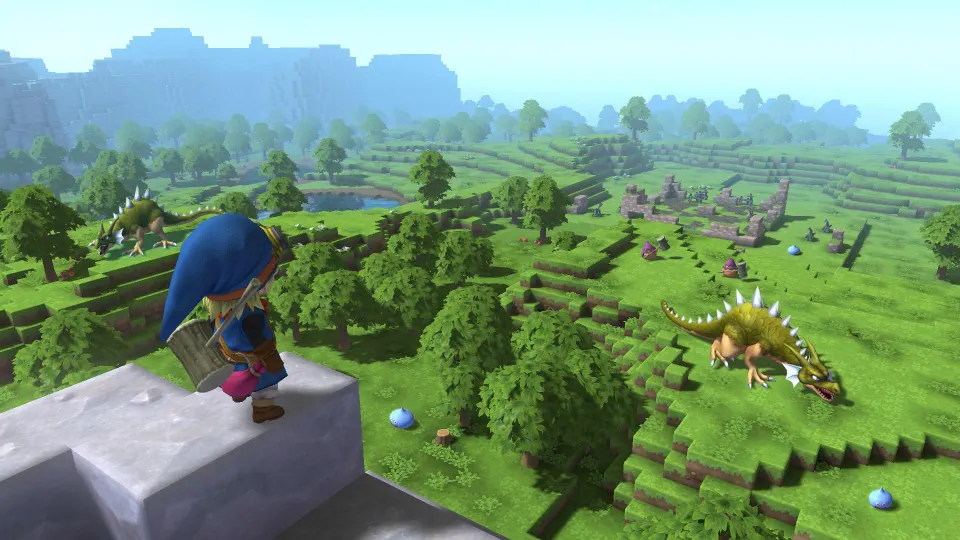
As mentioned, Dragon Quest Builders combines Mojang’s blocky, low-poly aesthetic with an action-RPG framework reminiscent of the earliest Legend of Zelda titles, putting players in the role of a hero—or heroine—known as “The Builder.” The kingdom of Alefgard has fallen into complete chaos, and only the one blessed with the power to build can restore peace. This premise works as both a narrative setup and a mission statement: in Square Enix’s title, players must not only brave a hostile world filled with monsters and hazards, but also gather resources, craft tools and structures, and help humanity reclaim its place from the forces of darkness.
Unlike Minecraft, however, Kazuya Niinou’s game is far more structured. It gradually teaches players how to craft items, tools, and accessories step by step. At first, the story provides direction, but as the adventure unfolds, the requests of the villagers take center stage, guiding the player’s actions. The result is an experience that never feels aimless, yet doesn’t hold your hand either.
Crafting is essentially “guided” by the ideas that come to the Builder’s mind whenever new materials are gathered or story milestones are reached. Resource collection, initially similar to Mojang’s game, soon becomes smoother thanks to an expanding inventory system that allows players to store items remotely in increasingly large chests. It’s clear that the sandbox and crafting mechanics have been carefully balanced—they’re engaging without becoming the kind of time-consuming ordeal that Minecraft can sometimes be.
The equilibrium between light town-management phases (each area essentially acts as a level with rising difficulty) and exploration or combat is remarkably well-crafted. I was genuinely impressed by the unlikely yet fascinating marriage between classic Japanese RPG tradition and Europe’s indie gaming sensibilities. The only weak spots in this delightful mix are the combat system—which, while functional, isn’t particularly refined—and the somewhat clunky placement mechanics for objects and materials, which can occasionally lead to frustrating moments.
The influence of a tighter, more deliberate Japanese design philosophy is evident, especially in how the game steadily opens up new possibilities for the player. Still, the sense of adventure and wonder is strong enough to make every expedition beyond the safety of the village walls an absolute joy. I found myself completely absorbed in Dragon Quest Builders and can’t wait to see how the community embraces its many creative opportunities in the asynchronous multiplayer mode, where players can showcase their own constructions.
A quick note on the technical side: Dragon Quest Builders was clearly designed with the PlayStation Vita in mind, yet its deliberately “low-poly” aesthetic—combined with Akira Toriyama’s character designs, even more rounded and expressive than usual—makes the world utterly charming. I might be going out on a limb here, but I’d say Dragon Quest Builders is among the most visually appealing entries in the entire series. It’s all topped off with a superb (if slightly self-referential) soundtrack by the legendary Koichi Sugiyama. Special mention also goes to the Italian localization, whose quality is fully in line with the mainline titles released in Europe.
If Square Enix’s efforts to bring Dragon Quest to a wider European audience find the success they deserve, then the next spin-off we’ll see is likely to be Dragon Quest Heroes II. Here’s hoping.
Dragon Quest Builders is a wonderful surprise, and its greatest achievement lies in how it bridges two seemingly distant gaming philosophies so harmoniously. It may be a carefully calculated commercial move, but damn—it’s a fun and wonderfully crafted one.