This article was originally published in Italian on TheGamesMachine.it
Nearly thirty years after its debut on the original PlayStation, Square Enix’s legendary tactical role-playing game returns to the spotlight on modern platforms. Final Fantasy Tactics: The Ivalice Chronicles is not, however, a simple reissue of the expanded version we enjoyed on the PlayStation Portable in 2007 under the subtitle The War of the Lions—it’s a faithful tribute to the original formula. This release serves as a celebration of the 32-bit classic created by some of the most prominent figures in Japanese game development, including Hironobu Sakaguchi, Yasumi Matsuno, and Hiroyuki Ito.
Although the intention was clearly to restore a ‘90s gaming icon as faithfully as possible, director Kazutoyo Maehiro—who also worked on the original title—has allowed himself some creative freedom. Final Fantasy Tactics: The Ivalice Chronicles is, without exaggeration, the best way to rediscover Final Fantasy Tactics in its most modern and accessible form.
Over the decades we’ve seen countless tactical RPGs played out on grid-based maps, but Final Fantasy Tactics was the first Final Fantasy title to belong to this genre. The credit goes to Yasumi Matsuno, who, after joining Square in the mid-1990s, was tasked with creating a tactical game based on a concept by Hironobu Sakaguchi.
The brilliance of the system designed by Matsuno and Hiroyuki Ito remains fully evident in this high-definition re-release. Moving units across grid-based battlefields is only the tip of the iceberg of a gameplay system that is both deep and complex, yet remarkably approachable in its most essential aspects.
The pace of combat is governed by a turn system known as CT (Charge Time)—now clearly illustrated by the redesigned user interface—while unit positioning remains crucial to achieving victory. Attacking an enemy from behind is always advisable, and offensive abilities like spells and special techniques are made easier to use thanks to a highlighted area-of-effect indicator that shows their range. In The Ivalice Chronicles, these tactical actions have been streamlined by near-instant load times and the option to speed up animations, while quality-of-life improvements such as rotating the map with the right stick, zooming out the camera, or switching to a bird’s-eye tactical view make the overall experience smoother and more enjoyable.
One of the most striking new additions is the ability to delegate unit control to an AI, with options to prioritize offense or protect specific characters. This makes random encounters—often a pacing nuisance in the original—far less disruptive, as they can now be entirely handled by the AI during the early positioning phase. Players can always take back manual control at any time if the situation isn’t unfolding as they prefer.
The growth system—one of the game’s defining features—still revolves around collecting and hybridizing job classes, this time based on the balance of the original Japanese PlayStation edition. This means that classes introduced in the PSP version, such as Onion Knight and Dark Knight, have been removed, but the result is still deeply satisfying in its original form.
Up to 50 units can now be recruited, and players can save job and equipment configurations for each one, making it easy to deploy customized party setups. According to the developers, The Ivalice Chronicles rebalances the entire experience on a large scale, adjusting equipment effectiveness, enemy strength, and player abilities. Fans of the game’s famously brutal difficulty, however, need not worry: the challenge level remains largely unchanged. The difficulty spikes that once marked pivotal battles are still present, as is the overwhelming power of Cidolfus Orlandeau. All the content from the PS1 version has been faithfully preserved, including Cloud’s cameo as a recruitable character from Final Fantasy VII, as well as never-before-localized “sound novel” mini-games—short, branching narrative stories.
It goes without saying that despite being surpassed in terms of gameplay complexity, balance, and scope, Final Fantasy Tactics remains one of the greatest tactical RPGs ever released on PlayStation, and this remaster reverently preserves its legacy.
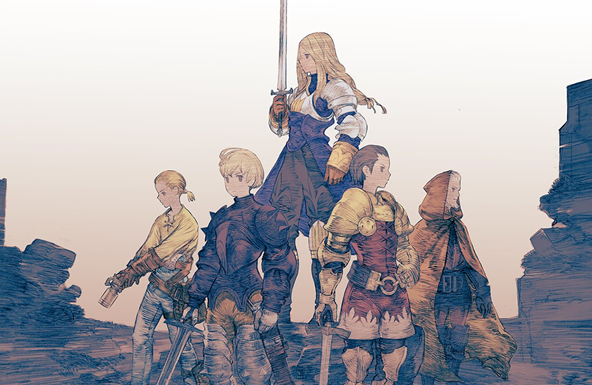
Yet newcomers to the genre shouldn’t be intimidated by this faithful recreation of its more punishing design elements. The remaster introduces numerous accessibility options, such as the ability to reload after each turn, quest markers that streamline side content navigation, an extensive library of tutorials and tips, and three selectable difficulty levels—including one designed for those who simply wish to enjoy the story of Ramza, the illegitimate son of House Beoulve, and Delita, his childhood friend from humble origins. Final Fantasy Tactics is renowned for its mature narrative and dark atmosphere, steeped in political intrigue and dramatic twists. For this re-release, Square Enix has recorded a completely new English voice cast (different from the PSP version) and an all-new Japanese one, with every line of dialogue delivered with theatrical flair.
It’s unfortunate, however, that the game does not feature a high-quality Italian translation that could somehow fill the void represented by this chapter in the collections of local fans; furthermore, it is useful to note that the script, here slightly enriched with scenes and dialogue exchanges during battles, as well as the use of names and terminology, refers back to the previous English translation seen in the PSP edition. Although formally correct, this revision of the English text in a theatrical style is often difficult to follow and rich in linguistic archaisms that have nothing to do with the original Japanese writing. While certainly appreciable by connoisseurs of English literature, we frankly remain doubtful that the choice to assign such an English script to the international audience – unaided by localizations – helps in the game’s fruition and the appreciation of its story.
The remaster also shines in its visual overhaul. For this occasion, it was necessary to compromise with the original artistic direction, but its pixel art remains intact. The use of filters on 2D assets is extensive, while a film grain effect is applied to the screen, dotting the image and giving it a texture similar to parchment. Even the scenarios, while remaining the same as the PS1 edition, are transfigured by watercolor-like textures and environmental effects that emphasize their three-dimensionality. The final result is more than decent, but if one is not entirely convinced by the revision offered by Square Enix, it is possible to simply play the original edition included in the package. If only they had included the PSP edition for completeness…
Final Fantasy Tactics: The Ivalice Chronicles is, in conclusion, a precious and respectful return of a work that marked the history of Japanese tactical role-playing games. Despite some questionable choices in terms of localization and the lack of an Italian translation, this re-release presents itself as the best possible opportunity to (re)discover a timeless classic, still capable today of surprising with its depth and narrative intensity. Square Enix chose not to distort the soul of the title, offering rather a bridge between past and present that knows how to value both nostalgic fans and new players: a faithful tribute and at the same time an invitation to immerse oneself once again, or for the first time, in the dark affairs of Ivalice.