This article was originally published in Italian on MyReviews.it in 2017.
Following the dictates of a market increasingly hostile to creative freedom, Square Enix brings the eighth chapter of the Dragon Quest saga to the magical realm of portable consoles—thus completing its mission to encapsulate the immortal JRPG series within the modest displays of the Nintendo DS first, and later the Nintendo 3DS. As of today, the entire saga conceived by Yuji Horii and illustrated by Akira Toriyama can be enjoyed exclusively on Nintendo’s handheld systems. In Japan, the trend of porting titles to portable devices was justified by the slow decline of the home console market, while in Europe the series found a true resurgence thanks to these enhanced versions—upgraded editions of games that, in many cases, defined the mythical decade of the 1990s.
With Dragon Quest VIII: Journey of the Cursed King, however, things are a bit more complex. This was the entry that most successfully captured the hearts of Western players, both for its high production values and for being the first title in the series to reach Europe through an official release rather than through fan translations or clumsy rebrandings. For Western audiences, it was simply Dragon Quest. This 3DS re-release restores its original numbering, rightfully positioning it as the eighth chapter in a saga that has now spanned more than thirty years and is preparing to celebrate its eleventh main installment. In short, this was an opportunity too good to pass up—and the good news doesn’t end there.
Just a few months after the splendid revival of the seventh episode, Nintendo and Square Enix once again joined forces to bring Europe another fine example of how a traditional JRPG can still prove both relevant and competitive in today’s demanding market. After all, this is Square Enix—a company capable of honoring its traditions while also venturing into new creative territory with ambitious, big-budget projects. Even Final Fantasy XV was preceded by World of Final Fantasy, a title that dared to reinterpret the formula while still drawing strength from the same legacy. Dragon Quest might not enjoy the same level of fame among Western audiences, but what players can now experience on Nintendo’s modest dual-screen console is an adventure that easily stands beside the most renowned titles in the genre—faithfully preserving the classic Dragon Quest formula.
The story follows the journey of a silent knight and his colorful caravan, led by a cursed king and his daughter, who have been transformed respectively into a small creature and a horse. Through flashbacks and the dialogue of companions, players gradually uncover the events that set their adventure in motion: the wicked jester Dhoulmagus has plunged the kingdom into despair, cursing the monarch and wreaking havoc on its people. True to the great Japanese storytelling tradition, Dragon Quest VIII paints a vibrant and fairy-tale-like world that soon reveals a surprisingly emotional core. Beneath its bright color palette and charming, cartoonish style lies a narrative that grows darker and more dramatic with every new chapter.
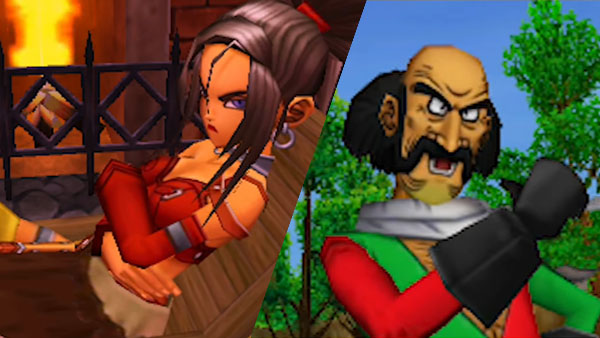
As Dragon Quest VII already proved, Square Enix and Level-5’s writers didn’t spare their heroes from hardship. Before long, players find themselves investigating a string of murders that claim the lives of several prominent figures from village to village. This journey leads the hero and his loyal companion Yangus—a reformed thief with a distinctive cockney accent—to meet new allies driven by vengeance, like the fiery Jessica, who joins them in pursuit of Dhoulmagus to avenge her brother’s death. The plot isn’t particularly complex or groundbreaking, yet it’s well-structured and engaging enough to keep players invested, especially those seeking a reason to lose themselves in the colorful atmosphere typical of the series. And in this regard, the game never disappoints. For returning players, it’s worth noting that this handheld version introduces two new playable characters—Red and Morrie—previously limited to supporting roles.
The list of improvements is long and easily justifies revisiting the game in this form. Random encounters have been replaced by visible enemies on the field, and various gameplay tweaks greatly improve pacing, which in the original PS2 release could feel somewhat sluggish. In other words, if Dragon Quest VII convinced you that classic JRPGs aren’t your thing, this entry might change your mind. Combat remains turn-based but now allows faster animations, while automatic HP restoration after leveling up saves players from constant trips back to town during exploration.
As characters grow stronger, skill points can be distributed across weapon specializations or unique abilities. In the past, this process offered little guidance, leaving players to guess at what future skills might unlock. In this version, however, the lower screen displays a detailed skill chart that clearly outlines each character’s progression—no need for online guides or guesswork. Those who prefer to wait can even save unspent points for later, giving players greater control over their party’s development. These seemingly small changes result in a more transparent and flexible system, empowering players to shape their own playstyle while retaining the series’ class-based structure. It may not offer the same degree of freedom as Dragon Quest VII, but it’s still remarkably solid. Combined with new story content and postgame additions, the overall experience remains faithful to the original while subtly refined. Rather than a full-fledged remake, this is best described as an enhanced port that streamlines gameplay and improves pacing without altering the soul of the game.
From a technical standpoint, Square Enix’s work deserves praise. The foundation laid by Level-5 on PlayStation 2 remains strong and instantly recognizable even after all these years. Early screenshots circulating online may have led to some unfair comparisons, but in practice the visuals—filtered through the 3DS’s lower resolution—hold up beautifully. The refined cel-shading that defines the characters’ look is still intact, capable of conveying a wide range of emotions just as it did before. Artists have focused on preserving the distinct appeal of the main cast, while minor adjustments to body proportions and outfits were made to suit the 3DS hardware—nothing noticeable unless you look very closely. The overworld, on the other hand, tells a slightly different story.
The vast, pastoral world map—one of the highlights of the original—returns fully explorable and rendered at a 1:1 scale, though occasional pop-in issues can cause distant enemies or objects to appear abruptly. Still, the technical achievement is impressive enough that criticizing the entire visual presentation for such minor flaws would be unfair. The overall artistic and graphical quality remains remarkably close to that of the home console version, and seeing the same cinematic cutscenes from such a massive game faithfully reproduced on a handheld device is genuinely impressive.
On the audio side, players will have to “settle” for an electronic soundtrack (the Japanese version featured orchestral arrangements), but the excellent English voice acting from the PS2 release returns, with a few minor recasts and some additional lines written for the new story scenes.
Dragon Quest VIII: Journey of the Cursed King on Nintendo 3DS stands as the definitive version of this beloved classic. Often dismissed as a “demake” with little merit, it instead proves to be an excellent addition to the already rich library of high-quality JRPGs available on the system—a must-play for any fan of the series.