This article was originally published in Italian on TheGamesMachine.it.
I had foreshadowed it, and after pushing well beyond the hundred-hour mark, I can only reaffirm my initial impression: Square Enix’s new JRPG is an ambitious and forward-thinking project.
Although presented as a console port of the unjustly overlooked mobile title Octopath Traveler: Champions of the Continent, this new Octopath Traveler 0 is, in effect, a full-fledged new entry in the series born on Nintendo Switch. Given the exceptional quality of its predecessor, expectations were inevitably sky-high. The question remains: Have DOKIDOKI GROOVE WORKS and Square Enix successfully upheld the legacy of Team Asano’s series?
Set once again on the continent of Orsterra—following the second episode’s foray into Solistia—Octopath Traveler 0 serves as a series prequel, casting players as a silent, two-dimensional protagonist in pure 90s JRPG fashion. It follows a classic narrative framework of the era, recounting the tribulations of the youth from Wishvale village, the latest victims of three aristocrats embodying the sins of power, wealth, and fame.
The village’s destruction marks only the beginning of two parallel paths: one is the survivors’ quest for vengeance, forced to bid premature farewell to their loved ones; the other is their arduous journey toward rebirth, built on hope and acts of self-sacrifice for the community. Octopath Traveler 0 grants players complete freedom to pursue either narrative thread, specifying only a recommended level at the start of each chapter.
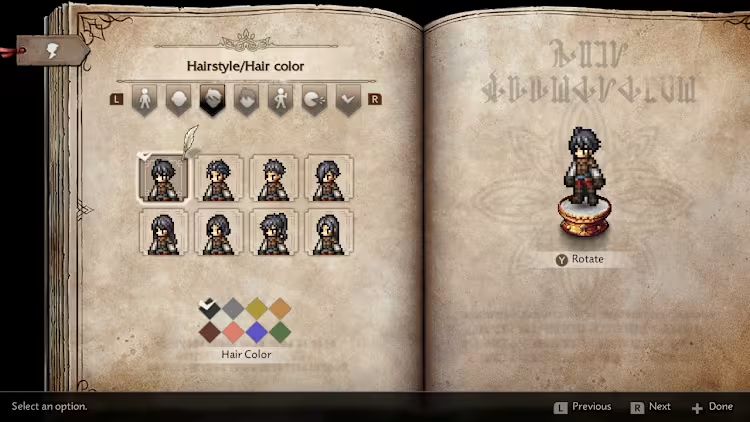
Unlike previous episodes, which alternated between eight distinct protagonists, this chapter offers a more traditional narrative experienced entirely through the eyes of a fully customizable hero. The tone remains the epic, often melodramatic hallmark of writer Kakunoshin Futsuzawa, but Octopath Traveler 0 focuses intensely on detailing the misery born from the corruption of human ideals.
Friendship, love, family—everything is scrutinized and re-examined to emphasize how every pillar of human reason can be twisted for selfish ambition. Consequently, the hopeful, idealistic struggle to rebuild Wishvale serves as a crucial counterpoint to the darker fables of the main adventure. This is a story of humanity in its totality, one that converges all its protagonists in a powerful and cohesive final act.
A clear warning is warranted: Square Enix’s title does not shy away from grim themes and uncomfortable ideas. It takes itself extremely seriously, leaving little room for lightheartedness—characters truly breathe only during optional side events or in party chat interactions within Wishvale. Significant care has been taken in characterizing the villains, whose presence defines the tone of each major storyline. That said, the theatrical flair of the writing—presented almost like a living pop-up book—often indulges in dramatic excess. This may alienate those seeking a neorealistic portrayal, but it works remarkably well if one accepts the overtly theatrical and emphatic narrative style from the outset.
While previous games offered greater tonal variety through multiple protagonists, this franchise experiment—paradoxically more traditional than the “Saga” model followed until now—remains effective, largely due to the quality and volume of events that shape the core narratives.
Let’s be clear: Octopath Traveler 0 is a long, dense game. Its main campaign can easily exceed a hundred hours. This is the result of condensing, rewriting, rebuilding, and expanding years of updates from the mobile Champions of the Continent (and not even all of them) into a full home-console release. Given the excellent outcome, one can only hope similar treatment might be considered for future projects.
The series’ trademark strategic depth returns in full force, now augmented by a major new feature: battles allow up to eight party members on the field, split between front and back rows. Formations can be modified at any moment by swapping two characters. This change pervasively reshapes not only character progression and customization but also the overall game balance. Our advice is to adopt an aggressive playstyle, focusing less on buffs and debuffs and more on pure offense.
The old hybrid-class system is replaced by a hero recruitment mechanic. Characters can be trained, and their active and passive skills can be shared among allies or found in the world. Only the main protagonist can change classes and learn every specialization’s basics, while the 30-plus recruitable characters can be flexibly customized but never fundamentally overhauled.
Each adventurer—including returning faces from the first Octopath Traveler—has traits tied to their specialization alongside unique defining abilities. The secret classes of past games are gone, yet the tactical depth remains entirely intact. The only casualty is the “Path Action” system; with a single do-it-all protagonist, the feeling of role-playing during exploration is diminished. It’s a sacrifice of the classic formula, but the core experience remains robust: players can invite NPCs to their village, persuade them with items, uncover their backgrounds, haggle with merchants, and challenge strangers to recruit them or obtain rewards.
The combat system retains its excellent turn-based foundation. Each precise hit on an enemy weakness breaks down their defenses (represented by a shield point gauge), and reducing it to zero puts the foe in a vulnerable “Break” state for the next turn—the prime moment to unleash your most powerful techniques. Successfully hitting weaknesses also builds a special gauge for unique skills: healers might grant temporary invincibility, while warriors can inflict damage exceeding typical limits.
The Boost system also returns: each turn grants a point to enhance attacks or multiply hits. Careful rotation of party members between rows is key to delivering devastating bursts when needed. Octopath Traveler 0 isn’t brutally difficult, but it is layered and demanding, offering a substantial challenge in its optional and post-game content.
Beyond combat, the game allows you to shape Wishvale. The system recalls Dark Cloud‘s diorama mechanics in a much simpler form. Building placement is aesthetic; the real progression comes from recruiting villagers and upgrading key structures like the inn, recruitment hall, and shop. Each resident contributes a skill that strengthens the village’s economy. Periodic visits yield items, ingredients, money, and even unlock new mechanics like training benched party members. This sense of growth and community is fostered not just by material rewards, but also through optional party chats that stage interactions among recruited adventurers—similar to tavern events in Octopath Traveler II. Deepening bonds with these characters unlocks valuable passive bonuses.
Technically, Octopath Traveler 0 represents a step back from the refined presentation of the second episode, aligning more closely with the original’s HD-2D style. This doesn’t diminish its charm; in fact, for a chapter set in Orsterra, the choice feels thematically appropriate. However, the rationale is clearer when acknowledging its mobile origins, as much of the presentation is a near 1:1 adaptation of the iOS/Android build.
The map and environmental design remain pleasing, utilizing the signature “three-dimensional” pixel art alongside abundant post-processing and particle effects. Puzzlingly, this modest aesthetic can cause noticeable performance stutters, even on PlayStation 5, particularly when entering new areas. These frame dips aren’t game-breaking but are consistently present.
High praise, however, goes to Yasunori Nishiki’s soundtrack. In his fourth outing for the franchise, he solidifies its musical identity with sweeping, poignant melodies, blending familiar themes with fresh compositions. Quality-of-life features also return in force: streamlined quest navigation, skippable cutscenes, battle animation speed-up, always-available fast travel, and encounter rate modification via accessories. An Italian localization is missing for the first time—though at least we are spared entire storylines in pseudo-archaic English (a pointed glance at H’aanit’s tale).
Octopath Traveler 0 is not merely an ambitious bridge between past and present; it is Square Enix’s most mature attempt to reconcile a mobile project’s legacy with the expectations of a premium home-console JRPG.
Its monumental structure, somber and uncompromising narrative, and richly layered strategic mechanics deliver an experience that, despite its gacha origins, stands proudly as an authentic and significant series chapter. It is a long, at times demanding journey that requires patience and dedication, but it rewards players with a profound sense of growth, community, and discovery—qualities that remain rare in the modern genre landscape. Octopath Traveler continues to represent one of the most coherent and passionate interpretations of the classic JRPG.