This article was originally published in Italian on GeekGamer.it in 2016.
A full 10 years have passed since Frank West first stormed into the Willamette Mall, in the fictional Colorado town. The work directed by Yoshinori Kawano (director of the Mega Man Zero series) and produced by Keiji Inafune arrived in the gaming world riding the initial popularity of the Xbox 360, in a generation that lasted just long enough to see its reputation first soar to become synonymous with great gaming, only to then plummet under the weight of exclusives published by Sony in the PlayStation 3’s later years of dominance. The fact remains that Dead Rising, with its aesthetic inspired by American cinema but its beating heart belonging to Japanese arcades, achieved such monumental success that it convinced the house of Street Fighter to turn it into a veritable new IP, entrusting the development of subsequent chapters to the Canadian team Blue Castle Games, now known as Capcom Vancouver. Needless to say, with the helm passing to a new development team and the passage of years, the all-zombie, camp-aesthetic saga ended up undergoing several transformations, to the point that today, of the winning mix of conspiracies, horror atmospheres, survival action, and a pinch of madness, only a bland copy remains. One only needs to watch any Dead Rising 4 trailer to realize it.
With the arrival of the trilogy of the first three Dead Rising titles (or rather the first two, considering Dead Rising 2: Off the Record is merely a stand-alone expansion of the second chapter) on current-generation consoles, Capcom has finally decided to break the unpalatable exclusivity deal that tied the series progenitor to Microsoft’s last-gen console, finally allowing everyone to sample the quality of one of the most intelligent and mechanically intriguing video games of recent years.
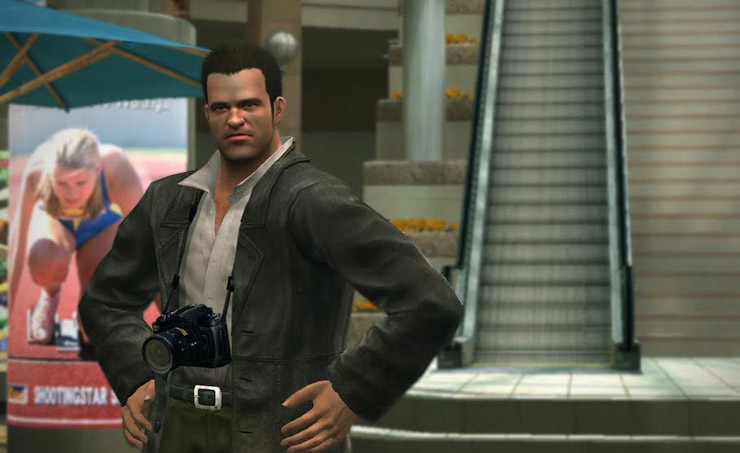
Granted that the story’s only task is to escort the player from one point to another in the huge explorable setting, in Dead Rising the player steps into the shoes of the corpulent Frank West, an unlikely freelance photographer in search of the scoop that could change his life. Thanks to his infallible intuition, our hero soon finds himself in the middle of a zombie epidemic, seemingly broken out in the town of Willamette, a sort of Raccoon City with a more bucolic appearance. The circumstances of the event matter little, as the narrative thread driving Dead Rising is nothing but an homage to George A. Romero’s Dawn of the Dead, confining almost all events to the perimeter of an enormous shopping mall to explore, memorize, and eventually become familiar with every corner of. At first glance, the title might recall an iteration of Koei Tecmo’s Musou series, but just pick up the controller and grind through the first few hours of gameplay to understand that engaging in killing the highest number of undead foes is merely the tip of the iceberg of a gameplay structure that makes timed objective management and exploration the two focal points of the entire experience.
A perfect example of how the title forcefully shuns the typical automatisms of modern products is the arrow that, at all times, sits at the top of the screen, showing the player where to go to reach the designated objective: as you progress through the adventure and internalize the topographical knowledge of the enormous warehouse, relying on this tool becomes increasingly useless, as you can opt for shortcuts and secret passages unlocked after escorting survivors or facing the mini-bosses scattered across the map, represented in the story by aggressive psychopaths.
Because while it’s true that Frank is interested in discovering the truth behind the town’s contagion, it’s equally established that his goal is to save as many living people as possible, intertwining their personal stories with a gameplay where every second is vital if you want to satisfy the completionist urge residing in each of us. Surviving for 72 hours (at least initially…) in a setting swarming with enemies often calls for evaluating your priorities, on the razor’s edge of a tension that is practically absent in the vast majority of contemporary video games. The greatness of Dead Rising lies in creating an enormous labyrinth where you face challenges of ever-increasing difficulty without ever giving players a break, but inviting them to improve from playthrough to playthrough, perhaps after the umpteenth game over prompts you to restart the adventure while keeping the power level reached after hours and hours of missions and battles. In Dead Rising, there are no free comforts, and every milestone must be earned with commitment, skill, and patience. A product with a typically old-school spirit that invites pursuit of a concept of virtuosity now vanished from the radar of contemporary releases.
Years later, the series’ first episode remains the most solid, packaged with coherence and respect for the player’s intelligence. Of course, since what Capcom organized is a port practically identical to its Xbox 360 counterpart, all the flaws highlighted at the time remain, and despite action now anchored to 60 fps, one must still contend with survivor AI that’ll make you want to tear your hair out (admittedly part of the work’s charm) and a now-aging technical compartment, albeit made more vivid and certainly pleasant to see thanks to support for high resolutions. The Japanese software house decided not to update the graphical assets used originally, and this translates into an aesthetic compartment that, without too much trouble, shows the marks of the years, but without making it a tragedy: faded textures and essential polygonal geometry cannot damage a gameplay structure as sophisticated as Dead Rising‘s, even years later.
There’s always time to step back into Frank West’s shoes, especially if it means doing so in the first episode of the Dead Rising series. Like a precise and orderly textbook, the saga’s debut title showcases in all their freshness all those characteristics that made the fortune of one of the very few new Japanese IPs that managed to impose itself on the market. To be preferred over any sequel, even considering the lack of multiplayer and assorted noisy features!