This article was originally published in Italian on Games969.com in 2015.
Despite a few hurdles and a noticeably slower pace compared to its competitors, Nintendo is slowly but surely catching up with the “indie craze” that has taken over digital storefronts on all major gaming platforms in recent years. For a modest price—around ten euros—you can now pick up some of the most complex and iconic titles to emerge from the chaotic whirlwind that is the independent game development scene. While Nintendo initially seemed uninterested in this movement, over time we’ve witnessed a gradual and welcome shift. This new openness has recently culminated in the arrival of indie hits that, until not long ago, would have been unthinkable on a Nintendo handheld—like the critically acclaimed The Binding of Isaac, which is now slated to launch on Nintendo 3DS and Wii U in its “Rebirth” edition.
It’s no surprise, then, that the house of Mario has begun developing its own breed of software aimed at enriching the growing catalog of low-budget yet creatively ambitious titles available exclusively through its digital store. Today we’re here to talk about Boxboy, developed by HAL Laboratory (of Super Smash Bros. and Kirby fame), which—without exaggeration—can be considered a little indie-flavored gem, despite clearly bearing the hallmarks of a classic Nintendo production.
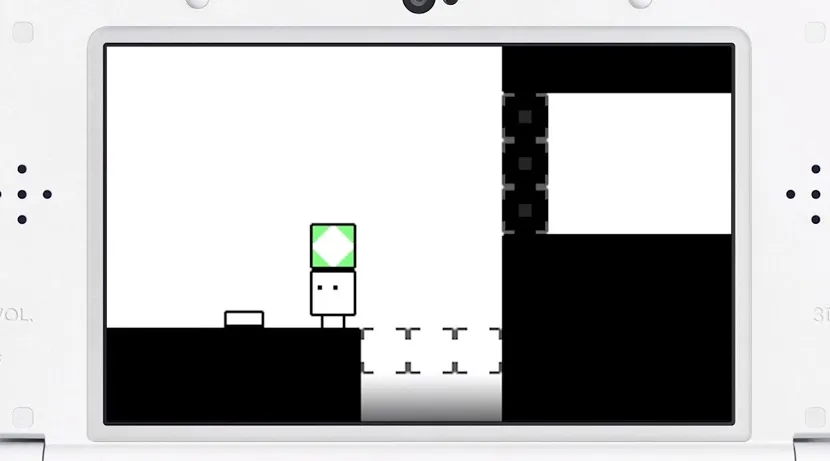
The concept behind this puzzle-platform hybrid is delightfully simple: the protagonist is a small square named Qbby. We don’t know much about him, other than the fact that he must save his monochromatic world from a strange creeping black substance. His only power is the ability to project a limited number of squares from his body, stretching and deforming himself in the process to overcome obstacles or navigate narrow, winding paths between different parts of each stage.
Don’t be fooled by the seemingly simple premise, though. Each level introduces as many twists on the core gameplay as those found in Valve’s now-legendary puzzle game Portal. In fact, the two games have more in common than you might expect, though Boxboy opts for the sacred silence once typical of older Japanese titles, shunning overt narrative in favor of quiet gameplay discovery. Both titles start with a single concept—dimensional portals in Portal, shape-shifting body mechanics in Boxboy—and steadily build on it through an escalating series of ever more complex and challenging levels.
Boxboy also offers intricate puzzle design that relies on activating switches, creating platforms, and applying out-of-the-box thinking to find unconventional solutions. Fittingly, the game was marketed in the U.S. with the slogan “Think outside the box”—a motto you’d do well to embrace from the very first level if you’re aiming to complete the game 100%.
What makes Boxboy truly shine is its elegant way of stimulating the player’s mind, introducing new gameplay variations every eight levels or so in a way that feels almost effortless. Each stage also contains collectible crowns, which must be gathered while keeping your number of “Qbby extensions” below a set limit—fail to do so, and the crowns disappear. Reaching the end of a stage rewards you with digital currency in the form of coins, which can be used to unlock costumes for Qbby or gain access to new challenges in previously completed stages.
If we had to nitpick, we’d mention that the game isn’t particularly long, with a total playtime of around 6 to 8 hours depending on how quickly you solve each puzzle. While there are a fair number of optional challenges to unlock, they don’t offer truly new content. The opposite is true for the game’s main campaign, which spans about twenty worlds, each made up of five to eight levels. The work of the game’s level designers stands out as some of the best 2D platforming design Nintendo has delivered in recent years—Captain Toad: Treasure Tracker on Wii U, released earlier that year, might be seen as its 3D counterpart.
It’s not easy to surprise players with clever new ideas in the 2D space, especially given the avalanche of indie titles that have flooded the scene, many of which are celebrated precisely for their experimental gameplay and fresh level design. And yet Boxboy manages to astonish. It makes you feel as if the same developers and artists who created it are sitting right there with you, playing along and marveling at your problem-solving skills.
The visual presentation brings the package full circle. Minimalist and clean, it features a black-and-white aesthetic with straight lines and a user interface reminiscent of Game Boy titles from the ’90s. The animations of Qbby and his friends are charmingly well-crafted, imbuing these simple squares with just two pin-dot eyes with a sort of silent charisma. We genuinely hope to see them return in a sequel—or perhaps a full home console release. After all, this is HAL Laboratory we’re talking about—the studio behind Kirby, a pink puffball with two dot eyes and a giant vacuum mouth, who has spent two decades becoming a cornerstone of kid-friendly fun. HAL: we dare say they’re a hallmark of Japan’s creative game development scene.
In short, for just five euros you can add one of the best puzzle platformers on the Nintendo eShop to your 3DS collection—a hidden gem that might go unnoticed due to lackluster marketing (honestly, who even knew this game existed?) and its digital-only release. Boxboy has character, style, and heart. It may not be the most original Nintendo title out there—and in 2015 it’s hard to call it a genre pioneer—but one thing’s for sure: this is a product that easily justifies, and even exceeds, its modest launch price. Grab it—and don’t forget to thank us later!