This article was originally published in Italian on GeekGamer.it in 2019.
Only a short time ago, I discussed on these very pages how State of Decay 2 felt more like a remake than a true sequel. With the release of Crackdown 3, a new exclusive for Microsoft’s gaming ecosystem, I find myself having to repeat the same sentiment.
This game is an action-adventure with third-person shooter segments that faithfully mirrors the structure of the series’ progenitor, a franchise that has now passed through the hands of three different developers. Packaged by British studio Sumo Digital, this new iteration of explosions and superhuman feats feels like a title designed for a market from at least ten years ago. Incidentally, the first Crackdown launched back in 2007.
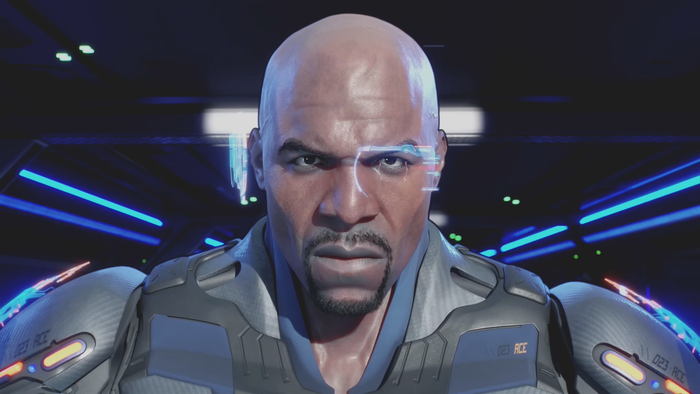
You assume the role of a generic “Agent” working for an organization of genetically enhanced soldiers, dropped into the metropolis of New Providence. This sprawling urban playground is packed with objectives. It would be remiss not to mention David Jones, the creator behind it all: he is the mind behind icons like the Lemmings series and, most notably, Grand Theft Auto. His reputation faltered in 2010 after the failure of APB: All Points Bulletin, a kind of precursor to today’s hugely popular GTA Online.
Thus, Crackdown should be understood as a sort of bastard child of the Rockstar Games lineage, a futuristic “what if” scenario. The protagonist is granted superhuman powers, cultivatable by collecting colored orbs scattered across the map. More importantly, every action taken influences your avatar’s statistics, defining their abilities with an immediacy that almost makes you forget its underlying RPG layer. This simple concept fueled the title’s success on Xbox 360 (helped by a Halo 3 demo included in every copy), convincing Microsoft to build it into a series.
After the original team dissolved, Microsoft entrusted Ruffian Games with a sequel, encountering several issues. The 2010 follow-up was ultimately too similar to its predecessor, yet remained fun and accessible, thanks largely to a cooperative online mode built on its sandbox foundation.
Now, fast forward to 2019, a year propelled by titles like Marvel’s Spider-Man and Red Dead Redemption 2. Is there room for a game “born old” like Crackdown 3? Sumo Digital, under Jones’s supervision and with Ruffian’s collaboration, has delivered a product intensely faithful to the original. Their joint effort aimed to create the most complete and accessible Crackdown experience yet. The singular problem is this: the game is essentially unchanged, trapped in a presentation and game design rooted in an outdated approach that struggles to compete today.
There is frankly little new to say about Crackdown 3. In this urban playground, you can: drive vehicles in a big city, shoot endlessly with a large arsenal, and scale initially insurmountable buildings that become trivial after collecting enough agility orbs. The game, while repetitive and simple (I recommend the highest difficulty), is packed with activities that frame your avatar’s progression at a breakneck pace.
Like Breath of the Wild, it allows a non-linear assault on the criminal hierarchy. You can pick off underlings or target kingpins early. Unfortunately, this promising mechanic doesn’t meaningfully alter the experience. Eliminating minor bosses merely grants experience points for stat boosts; it doesn’t reshape the world. In fact, with a max-level avatar, you can skip straight to the final boss and complete the campaign in under ten minutes.
So, it functions exactly like the 2007 original: you enjoy vertical cityscapes, hunt collectibles, and tackle side activities like rooftop races. Beyond that, Crackdown 3 reveals itself quickly: a loud, chaotic third-person shooter lacking the flair of something like Saints Row. It is sloppy and unoriginal. Online co-op slightly alleviates the bland single-player campaign but feels ancillary.
We must also recall this project’s original promise: to use cloud-processing for total environmental destruction, a feature showcased for years in ambitious tech demos. The final result is far less impressive. While the game runs smoothly at 30fps on Xbox One X and uses HDR well for its neon-drenched explosions, it pales in comparison to other modern blockbusters.
This isn’t to say it’s technically poor. It’s clean and stable, even in chaos, though it uses dynamic resolution, not true 4K. The art direction simply fails to mask sterile, lifeless geometry, resulting in a city that feels empty next to earlier-generation titles like inFAMOUS: Second Son. And yes, the cloud-processing is entirely absent from the single-player campaign.
The terrible physics engine, making vehicle handling awkward and character movement ridiculous, only reinforces its early-2000s slapdashery. Environmental destruction is confined to the multiplayer mode, which was deserted within a month. This mode, with just two modes and a handful of maps featuring destructible buildings, fails to deliver on years of promotional hype.
To be blunt, this new Microsoft exclusive is barely worth the discounted February Xbox Game Pass renewal fee of €2. Crackdown 3 is a disguised remake of the first game, shamelessly parading stale mechanics. Its technical reality renders years of marketing material almost misleading. It’s an action-adventure born obsolete, tasting distinctly of a bad 2000s game. That very fact might, perversely, be its only appeal for some.
And remember: they gave away the original Crackdown for free just weeks before this launch. That one actually runs in true 4K.