This article was originally published in 2021 in Italian for the no.0 issue of the magazine Kuma. More info here.
“Someday the next great emigration will occur, as we leave this existence looking for another.
The journey will begin anew.”
Rez (Area 5)
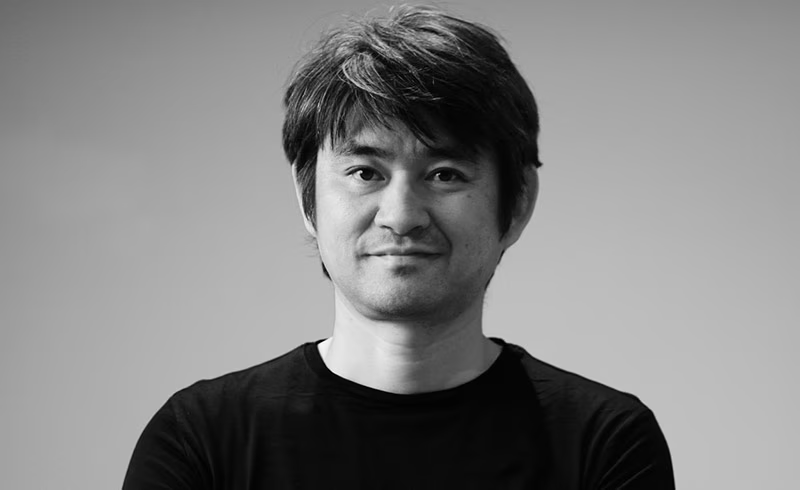
From the earliest days of his artistic career, Tetsuya Mizuguchi made a name for himself by creating games that looked toward the future, blending the conventions of contemporary gaming with a forward-thinking vision aimed at stimulating the player on multiple sensory levels.
Born in 1965 in Sapporo, Japan, and a graduate of Nihon University’s College of Art with a degree in media aesthetics, he chose to take his first steps into the video game industry at SEGA. As he later admitted, it was the only company at the time that was experimenting with emerging technologies. His disinterest in the games of the era was so pronounced that during his job interview he referred to SEGA’s own console as a “Famicom”, the shorthand for “Family Computer”, Nintendo’s competing system.
Mizuguchi’s intentions differed from those of his peers. He wasn’t drawn to the competitive spirit that defined gaming at the time, fueled by the chase for high-score leaderboards at the end of every play session. He had no desire for players to measure their joystick skills or their technical prowess. His goal was to design interactive experiences that would allow him to study how players reacted to stimuli that only a “complete” simulation like a video game could offer. After all, he already understood art and its emotional impact, and he still holds a clear belief on the matter: “often it simply comes down to personal taste.”
His career was a steady rise, initially shaped by industry trends and the cold logic of arcade popularity charts. At SEGA he worked on influential entertainment software such as the SEGA Rally Championship and SEGA Touring Car Championship series, but also on projects that reflected his growing interest in simulating experiences that technology could not yet fully support, reshaping the conventions of the time.
The SEGA AS-1 machine, paired with a software experience called “Megalopolis”, is perhaps the most fitting example of his creative approach. It was an enormous arcade cabinet built to accommodate two players, recreating a futuristic car chase inspired by the science-fiction novels of Philip K. Dick. The cabinet moved on a hydraulic system synchronized with on-screen footage, with music and sound effects enhancing the sense of immersion. Naturally, it relied on the sensory feedback available at the time, with the entire cabin physically tilting to mimic an action sequence straight out of Hollywood. The players, however, had no way to interact with the experience. It was a pre-rendered 3D sequence meant solely to evoke a delicate sense of wonder, offering movement, sound, and 3D imagery as its core components. Mizuguchi himself has always been honest about it. To him, it “never was a video game”, but rather a project he believed in, closer to a theme-park attraction, and one that allowed him to experiment with the multisensory stimulation that would define his work in the years to come.
In 1998, during a business trip to Europe for the development of Sega Rally Championship 2, he had an experience that would forever shape his artistic output. While traveling with friends, he found himself in the middle of Zurich’s Street Parade, one of the most important events in electronic music culture. The flashing lights, neon colors, and the disordered movement of over a hundred thousand dancing bodies guided by a single DJ with pounding rhythms and synthetic sounds struck him deeply. He became convinced that this was the kind of experience he needed to recreate in a video game.
When Shoichiro Irimajiri replaced Hayao Nakayama as president of SEGA in 1999, the opportunity Mizuguchi had been waiting for finally materialized. SEGA wanted new software for its upcoming console, the Dreamcast, and aimed to create digital experiences that could attract an audience beyond dedicated gamers. The company wanted to reach adults who had never touched a game before, artists of all backgrounds, and even the large but unpredictable market of women with strong purchasing power such as university students, fashion-conscious teenagers, and even housewives. It was time to form the legendary team he would soon lead, United Game Artists, known as UGA.
Bringing together former colleagues and artists from other creative fields, such as Jun Kobayashi and the musical collective Mommy’s Endorphin Machine, Mizuguchi created an aesthetic and musical partnership that produced two of the most important rhythm-based video games ever made. Although “rhythm game” often feels like too narrow a definition for UGA’s output, the team left an indelible mark on the genre and influenced Western developers who still cite their work today.
Despite his varied output, Mizuguchi’s most famous and beloved work is undoubtedly REZ (Dreamcast, PS2, 2001). Initially conceived under the codename “K Project”, it stemmed from his desire to evoke in players a “pleasant sensation” that would continue to grow throughout the experience. It was such an unusual yet fundamental idea that explaining it to the team proved difficult. Mizuguchi has said he even felt guilty at first for failing to give a clear sense of direction. At the start of the 2000s, REZ brought a masterful blend of on-rail shooter mechanics and an audiovisual style designed to create what he described as a synesthetic experience. Every action created a sound and a controller vibration, accompanied by flashes of light and polygonal choreography. Like a chain reaction, it satisfied each area of perception: producing sounds from silence, music from sounds, and visuals from music. It wasn’t software that aimed to create music, but a process that ended up generating it through play.
The story of REZ is minimal and conveyed through brief text messages presented like debugging logs. The manual included with the game helps clarify the premise: players take on the role of a hacker diving into the cyberspace of the K Project, a futuristic evolution of today’s internet. Their mission is to eliminate the viruses that threaten Eden, an artificial intelligence positioned at the center of the infected network. Although the game lacks a traditional diegetic narrative (all messages are directed at the player, not the avatar), REZ adopts a unique visual identity inspired by the philosophy of Russian painter Wassily Kandinsky. Like Mizuguchi, Kandinsky blended visual art with musical inspiration, seeking multisensory fulfillment that transcended purely visual forms. UGA’s artists borrowed from his abstraction to create a world where spaces and shapes merge seamlessly, providing information through transmedia representation.
The cyberspace of REZ consists of wireframes and skeletal polygonal structures floating in front of an unsettling black void. The player’s avatar serves as the main on-screen indicator, evolving from a simple sphere to a humanoid silhouette, passing through intermediate stages between abstraction and humanity.
The levels, named after planets in the solar system, seem to draw connections between the great cultural milestones of human progress and the vastness of the universe in which we drift, the monochromatic digital space corrupted by the game’s narrative. Each stage includes imagery and aesthetic elements inspired by the art and architecture of various civilizations, unfolding to electronic music that evokes ancient worlds and symbolic interpretations of discoveries such as commerce, philosophy, warfare, and mathematics. Some elements seem to explore themes common in science fiction, such as the relationship between humans and machines, accompanied by tracks like Adam Freeland’s “Fear is the Mind-Killer”, which repeats a quote from Frank Herbert’s Dune like a mantra.
As the “journey” touches on human concepts, it is only in the final stage that the perspective shifts. The gaze of the living is replaced by the perspective of an “other” being, reflecting on human evolution through terse text messages between levels. Eventually, players learn that this viewpoint belongs to Eden, the AI who oversees the K Project. Despite being modeled after a female human form, Eden questions her own nature, falling into despair as she contemplates what she is. Her story concludes with a vision of butterflies formed halfway between digital and organic matter, coexisting in a bright, open space free of uncertainty. A single line from Eden’s digital voice marks her awakening: “I am.” Curtain falls.
In Japan, REZ was sold alongside a USB accessory called the “Trance Vibrator”, produced by ASCII. It transmitted the same vibrations generated by the controller, and was meant to be placed on the body to dramatically enhance immersion, or used by a spectator to share the synesthetic experience normally reserved for the active player. Mizuguchi’s idea was to entertain with something different, but also to evoke an emotional reaction that would make every session unforgettable. This search for the human element within an immaterial, abstract space left a lasting mark on the industry. Its emotional legacy blossomed again in REZ Infinite (PC, PS4, 2016), a VR adaptation enriched with a new final level built using modern technology. The promotional videos showed players moved to tears beneath their VR headsets, overwhelmed by the intensity of the experience. One only needs to play it to understand how powerfully the sought-after “synesthesia” has survived over time. REZ remains as fresh and immediate today as it was two decades ago.
Ultimately, the universe Mizuguchi created serves as a means to explore human nature and its evolution through an abstract perspective that exists “above the human”, a decision partly motivated by his desire to distance himself from the industry’s obsession with realism. At SEGA, highly realistic projects like Yu Suzuki’s Shenmue set the company’s direction, but Mizuguchi resisted this trend. It is a divide that mirrors the difference between figurative and abstract art, a contrast that continues to shape gaming today.
After leaving SEGA due to internal restructuring and artistic disagreements, he founded Q Entertainment, beginning a prolific period of puzzle games with strong musical and visual identities, including the Lumines series, Meteos, Every Extend Extra, and Gunpey, a reimagining of Gunpei Yokoi’s puzzle game. His most ambitious post-SEGA project was announced in 2010 on Ubisoft’s E3 stage in Los Angeles. It was Child of Eden, a spiritual successor to REZ built around the capabilities of Microsoft’s Kinect for Xbox 360. Here, the wireframes, pounding rhythms, and oppressive darkness of outer space gave way to marine-themed environments with brighter colors, harmonious melodies, and shapes inspired by early aquatic life. Kinect tracked the player’s gestures and translated them into shooter-on-rails mechanics not unlike those in REZ. The game was later released on PlayStation 3, where the lack of Kinect support shifted control to the traditional gamepad or PlayStation Move controllers.
In a 2017 interview with Toco Toco for an Archipel documentary directed by Anne Ferrero, Mizuguchi expressed his desire to continue exploring how new technologies can connect with the most instinctive and emotional side of players. His goal is to keep creating projects that use technical innovation to stimulate emotional responses. It is a statement perfectly aligned with his entire artistic and creative trajectory.
After leaving Q Entertainment and spending a period away from development, Mizuguchi is now a professor at Keio University’s Graduate School of Media Design in Tokyo and has returned to the spotlight as the founder of Enhance, Inc., where he serves as CEO and only employee. In 2018 he announced he was working on an expanded version of the classic puzzle game Tetris, titled Tetris Effect, inspired by the psychological theory proposed by American psychiatrist Robert Stickgold, with full VR support. Today it has won countless awards, holds a Metacritic score of 90 out of 100, and is available on all platforms in an expanded edition titled Tetris Effect: Connected, which adds cooperative and competitive online modes. It is a world held together by music and the essential geometric forms that once made REZ the timeless masterpiece of the sorely missed UGA team.