This article was originally published in Italian on GeekGamer.it in 2020.
The release of a remake of Resident Evil 3 so soon after the debut of the second installment’s remake should surprise no one: the success achieved by Capcom in recent years is such that it can justify any investment. In the case of this specific, record-time production effort, we are once again faced with what is, for all intents and purposes, a reboot in disguise, or—better yet—the outcome of a rethinking of a title that represented, in its day, the swan song of the series on Sony’s 32-bit console. And if Resident Evil 2 remake could count on the synergy of two different directors, Resident Evil 3 boasts no fewer than four. Among them are Yasuhiro Anpo, already involved in the re-edition of the Leon Kennedy and Claire Redfield epic, and, among the new faces, Kiyohiko Sakata, formerly of Platinum Games, who was a key figure in the past development of Resident Evil 3: Nemesis, but also (and especially) of Resident Evil 4, Vanquish, God Hand, and The Wonderful 101.
In fact, Resident Evil 3 is nothing more than the natural action-oriented evolution of that Resident Evil 2 we learned to appreciate a few months ago on PS4, Xbox One, and PC. This evolution mirrors what happened in the late ’90s with Resident Evil 3: Nemesis for PS1—a project initially conceived as a spin-off chapter, granted a modest budget, but which, precisely for that reason, could dare to introduce more interactive variety and unique mechanics compared to the gameplay skeleton of the highly praised Resident Evil 2. All in all, then, one can say that a certain degree of fidelity to the original intentions remains, despite the obvious aesthetic and structural differences and the elimination of a significant amount of content present in the original edition. A matter of lack of time or the legitimate authorial will of the new directors?
Developed internally by Capcom with the help of M-Two, a Japanese software house founded by Tatsuya Minami (also ex-Platinum Games), Resident Evil 3 brings back to the stage Jill Valentine, the first iconic protagonist of the survival horror saga par excellence. The remake shuffles the deck while adhering to the original premise: at the dawn of the zombie apocalypse in Raccoon City, the player is called to guide the last remaining member of the special S.T.A.R.S. team, struggling to survive the destruction of a burning metropolitan setting and escape the threat of a disturbing humanoid monster. One could say the commonalities with the old title are limited to this slender narrative premise and the revived cast of characters, as the screenplay of the new Resident Evil 3 and its relentless storytelling leave no room for nostalgic temptations. A choice ultimately inevitable, especially considering the myriad naiveties that populated the original script penned by what was, for all intents and purposes, a debutant screenwriter and the clunky direction of titles from that era. A 1:1 translation, in short, was ill-advised for obvious reasons. Overall, however, the Capcom title remains focused on the story of a desperate escape (“Last Escape,” as it was defined in the Japanese version of the PS1 edition), but it aims to establish narrative continuity with what was seen in the Resident Evil 2 reboot. Precisely for this reason, therefore, this “remake” also required appropriate modifications to the screenplay to be plausible—although a willing suspension of disbelief is still indispensable on multiple occasions.
The first to undergo substantial changes is the protagonist, Jill Valentine, an icon stripped of her old role as a sensual post-apocalyptic doll and reinvented as a woman endowed with extremely practical skills and a cheekiness that borders on vulgar at times; characteristics that make her much more credible in certain circumstances, especially when contrasted with the military rigor of the swaggering Carlos and his armed colleagues. Jill’s reinvention is functional to a narrative line in which events follow one another at a relentless pace, forcing the characters to make extreme efforts and plunge headlong into situations, even when the only escape route is fraught with dangers and monstrous threats. If the interactions between Leon and Claire in Resident Evil 2 seemed forced to me, the sporadic exchanges between Jill and Carlos come across as much more realistic. Their relationship is direct and brisk, dictated by the impetuous flow of events rather than by dramatic contrivances or poorly concealed adolescent infatuations. After all, Carlos’s presence as the iconic Jill’s sidekick is notoriously confined to this chapter of the saga, and unlike the aforementioned Claire and Leon, the Hispanic mercenary never fully belonged to Capcom’s pantheon of heroes. His almost archetypal characterization works perfectly in a diegetic context little inclined to psychological depth and more interested, rather, in conveying anxiety and tension.
From this point of view, the intentions of the original title have been followed to the letter right from the introduction, in which Nemesis immediately reveals itself in all its ferocity to a terrified (but still combative) Jill during a spectacular chase sequence.
This Resident Evil 3, in short, is configured as the product of a contemporary reinterpretation of the original PS1 concept and does not yield to the temptation of tickling the nostalgic fantasies of older players. And this, in the opinion of the writer, can only be a good thing. Those who worked on the screenplay, in my opinion, understood the intentions of the original premise and the key roles of its protagonists and knew how to respect them while largely rewriting them.
The concept I would like to be clear is only one: Resident Evil 3 Remake embodies the natural action-oriented evolution of the aforementioned Resident Evil 2 Remake, replicating exactly the principles of the relationship between their respective original PS1 titles, but transferring them into an updated perspective. We start again from the same skeleton as RE2, namely a third-person shooter with an over-the-shoulder camera and dynamic direction designed to immerse the player in the atmospheres of an “evolving” scenario, considering that Jill’s reckless escape begins simultaneously with the start of Raccoon City’s destruction. If the young protagonists of the previous chapter had the advantage of having to “only” survive what remained of the American town after the great disaster, the S.T.A.R.S. agent is not so fortunate and must immediately confront a large number of undead enemies against the backdrop of a city in flames. Fortunately, Jill—as well as Carlos, playable for a brief period—is not exactly a novice and demonstrates superior mobility to the callow protagonists of the prequel while also relying on military training immediately put into practice. The protagonist can indeed dodge attacks—provided the player demonstrates good timing, controller in hand—and, when trapped by an enemy, can reduce damage taken if the player rapidly presses an on-screen button prompt. The solution is certainly not innovative, but the instinctive frenzy of its mechanic effectively conveys the pain and urgency of every single close-quarters encounter.
The four directors in charge chose to stage the entire experience as if it were the minute-by-minute chronicle of a survivor’s escape in a Romero-esque zombie apocalypse. For consistency, game mechanics, level structure, and narrative lines have been adapted with the aim of eliminating downtime or reflective pauses: in a context where one is constantly threatened by monstrosities of various kinds, the game thus privileges dynamic aspects and frontal clashes precisely to convey a sense of urgency and danger. Consequently, what suffers are the characteristic backtracking of classic titles, the exploratory components and puzzles, as well as that atmosphere of suspended unease that was decisive for the success of the first chapter and, in part, of the second’s remake. The final result of this compromise is an experience in line with today’s standards, faithful to the spirit of the original title, but at the same time stripped of the cloying inertia of cinematic video games. Resident Evil 3 is keen to present itself above all as a video game: although the photorealistic aesthetic (guaranteed by the use of photogrammetry) brings it close to a Hollywood action feature film, one never feels dragged forward by endless cutscenes interspersed with brief interactive scenes—a now omnipresent plague in the contemporary gaming landscape. Thanks to the wise dosing of the duration of every non-interactive scene, one always feels fully in control of the fleeing Jill, even when the action gives way to highly spectacular scripted sequences that highlight the gruesome deeds of her monstrous nemesis, amidst deliberately unnerving quick time events and shooting sessions that leave little room for experimentation by less experienced players. The balance is excellent and erases the memory of less inspired predecessors like Resident Evil 6, perhaps the most controversial iteration of the entire franchise. I mention it here because, at times, this title recalls it in its rhythm, especially in some scenarios where the action seems to take precedence even over the horror component. Fortunately, the synergy between the four directors must have contributed to avoiding the risk of making Resident Evil 3 Remake an anonymous third-person shooter to be completed on any random weekend: despite some less inspired moments, the balance between horror elements and shooting sessions remains stable until the final stages.
It has been said how Resident Evil 3 Remake only loosely inspires itself from the PS1 title and does not bother to respect its structure or peculiarities, borrowing from its recent predecessor most of the graphical assets, some settings, and a now well-worn gameplay skeleton. Certainly, hypothetically, it would have been possible to bring back to life some of the intuitions introduced by the original chapter and re-evaluate them for today’s market, and that would surely have helped satisfy long-time fans in search of old emotions and give more character to the product packaged by Capcom and M-Two. Among the illustrious absentees, for example, is the Live Selection mechanic, which forced the player to make immediate decisions when faced with “forks” capable of influencing the flow of events; or, again, the sophisticated ammunition crafting process, which appears overly simplified here, not too differently from what was seen in the second chapter’s remake. Once the credits roll, one realizes they are faced with a certainly high-profile video game, but somehow less refined than it could have been considering the dynamics hypothesized by the source material. One almost wonders if certain choices were not conditioned by the rush to launch a new title on the market by capitalizing on the renewed popularity of the brand.
The length of the campaign—strictly single-player—does not differ from that of any other chapter in the series. However, after reaching the credits for the first time and unlocking the in-game shop where you spend in-game currency, you begin to understand how this chapter of the saga also wants to promote, above all, an exquisitely arcade speedrunning approach. Only during New Game+, in fact, does the game introduce the possibility of applying modifiers that affect the protagonists’ stats and the effectiveness of their weapons. Since there is no second playable campaign, one can only allow for a nimble revisitation of the main story, perhaps making some key items available from the start and permitting the use of special weapons, certainly indicated for the higher difficulties. Small consolation for those who are not lovers of the arcade approach, especially considering the total absence of interesting rewards like extra modes or bonus costumes (apart from one for Jill, when Resident Evil 3: Nemesis in 1999 had at least five). Nothing too important, of course, but this effective underlying “poverty” seems to confirm the suspicion that this reinvention of Nemesis and co. was completed in haste without offering less hardcore players a sufficient reason to repeat the gaming experience.
Evidently aware of this, Capcom wisely thought to offer the title at full price bundled with Resident Evil Resistance—an online multiplayer spin-off where teams of four survivors must deal with a fifth player in the role of the “bad guy” of the moment, who spies on them from cameras and unleashes traps and monsters of various kinds against them. On paper, it would be an interesting project—although personally, I would have preferred a revisitation of the Resident Evil Outbreak chapters published on PS2, which are also considered canonical and no longer accessible—but the almost total lack of content at launch and the presence of much more polished titles in the 4vs1 asynchronous multiplayer sector (for example, Dead by Daylight) certainly did not benefit the popularity of Capcom and M-Two’s experiment. As I write, Resident Evil Resistance is nothing more than a meager multiplayer title that probably would have made more sense if it had been distributed in free-to-play form and expanded over time with the support of a community of players who would be quite happy to approach the Resident Evil brand without having to pay an entry ticket of between €50 and €60.
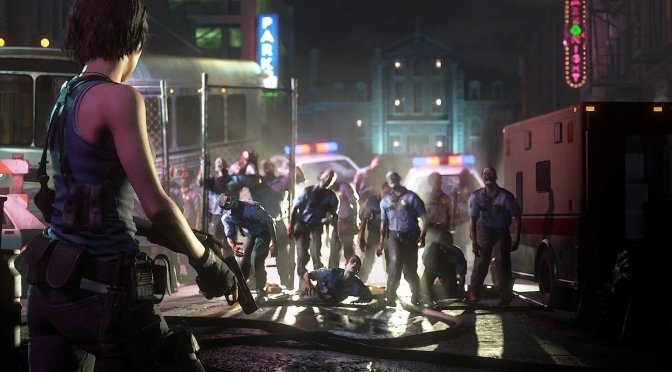
Finally, a couple of words must undoubtedly be spent on the technical and artistic compartment of this remake, yet another production developed with the RE Engine. The excellent graphics engine conceived internally at Capcom delivers a visual impact in line with the very high standards desired by the artistic team behind RE2 Remake and ensures a sufficiently fluid experience on practically every gaming platform, even on PS4 and Xbox One S, hardware now obsolete from every point of view. The artistic direction, on the other hand, deserves credit for having skillfully outlined unseen aspects of Raccoon City, considering that the incipit places the events at a different moment in history compared to the previous chapter. Albeit briefly, we are given the opportunity to glimpse signs of life in the city’s streets, populated by small businesses, neon signs, public transport, and traces of nightlife. The overall effect benefits from greater variety in the design of enemies already faced in the prequel and from the skillful packaging of the atmospheres: action moments are illuminated by the aseptic pallor of streetlights or the crackling of flames engulfing ruins on the sides of the pavement, while the colors of metropolitan life are blackened by ash or soiled by the blood shed by the victims. A less gloomy and more visceral chapter, in short, on the occasion of which two of the most popular characters in the entire franchise have been redesigned. On one hand, we find a Jill Valentine dressed less provocatively and more practically, enhanced by the beautiful, expressive face of Russian model Sasha Zotova and the voice of energetic American actress Nicole Tompkins (in Italy interpreted by Debora Magnaghi, already the official voice starting from Resident Evil Revelations, but especially of Memole); on the other hand, there is Nemesis, made even more terrifying through facial features that emphasize his feral nature. Both respect the unmistakable color palettes of their ’90s counterparts—and in this they differ from the drastic redesign of Claire Redfield seen in RE2 remake—but at the same time have undergone a careful updating process that blends well with the new photorealistic aesthetic. Certainly, I am still not entirely clear on why, during the promotion phase, Capcom wanted to push the fact that the new Jill appears “less sexy and more feminist” only to then include in the game a scene where enemies attack her by staging a deep-throating act, but the company’s PR department probably knew what it was doing. For fair play, however, it would have been interesting to witness similar moments with Carlos as well, instead of obliging him to step into the shoes of a Rambo emulator.
After the successes gathered in recent years, Capcom simply could not refrain from bringing back to light the third chapter of the Resident Evil series, powered by the miraculous RE Engine. All things considered, one could almost speak of an additional scenario for its prequel, but what really matters is that it is 90% almost entirely new material. A reboot operation that, as I already said in my RE2 Remake review, cannot replace the original and can only walk alongside it, while simultaneously representing the new canon of the series. Rediscovering Jill Valentine and her battle against Nemesis remains a joy nonetheless, as we turn our thoughts to the already much-rumored remake/reboot of Resident Evil 4 in development at M-Two’s studios…