This article was originally published in Italian on TheGamesMachine.it
The case of Atelier Resleriana: The Red Alchemist & The White Guardian is a unique one. In essence, it is the twenty-seventh entry in the Atelier series, but it is also a direct sequel to a PC and mobile title that, at least in Europe, was shut down prematurely due to low player engagement. This dual nature makes it both a rather traditional iteration of the ever-experimental Atelier series and the continuation of a universe that failed to garner significant acclaim.
A true shame, considering that with The Red Alchemist & The White Guardian, the series has returned to a more classic formula dedicated to alchemy-centric mechanics, which were somewhat sidelined in the recent Atelier Yumia in favor of a greater focus on vast open-world exploration.
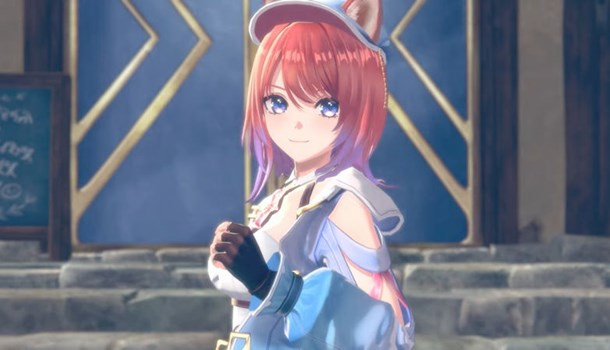
The story’s protagonists are Rias and Slade, two youths linked to the city of Hallfein. At the game’s outset, players can choose which of the two to follow more closely, but in practice, the game’s story almost always features them together as dual protagonists. Following clues from ancient manuscripts, the two discover an abandoned alchemy workshop. Their combined efforts will lead them to delve into the mythical origins of their village and uncover the mysteries behind the disaster that ruined the city and caused its inhabitants to vanish twelve years prior.
As one would expect from the series’ typical formula, Atelier Resleriana: The Red Alchemist & The White Guardian follows the exploits of its two young protagonists as they grapple with alchemy, an art forgotten in Resleriana’s universe that can only be utilized through a force called Mana. Assisting them are not only the locals and Slade’s brilliant adventuring companion, El, but also a sizable cast of familiar faces from previous franchise entries.
Introduced as “travelers,” this chapter—like the mobile episode it’s named after—allows players to rediscover the personalities of dozens of characters from past titles. This is undoubtedly a major point of interest for fans, as not only do beloved characters like Ryza or Sophie return with their bubbly personalities, but so do figures less famous in the West, such as the serious Rieze from Mana Khemia 2: Fall of Alchemy, or even the young Totori from Atelier Totori. The life of Rias and Slade after their meeting is told through a narrative with lighthearted, yet never superficial, tones, adventurously and vibrantly exploring the relationships that form with the various alchemists visiting Hallfein. It’s a story whose events lead the two protagonists to further investigate their desires for the future, offering different cinematic scenes depending on whom you choose to follow.
Atelier Resleriana: The Red Alchemist & The White Guardian offers plenty of fan service for enthusiasts, but it also presents itself as an adventure with decidedly optimistic and sweet tones, characterized by mysteries to solve and narrative twists typical of the JRPG genre. With a strong “slice of life” identity, the framework through which the Atelier series tackles the adventure’s central events is that of a coming-of-age tale for adolescents, though the stakes gradually rise as the story progresses.
Fortunately, the gameplay system is well-established, even if it distances itself from the recent Atelier Yumia or the Atelier Ryza trilogy; it more closely resembles the structure of Atelier Sophie 2. A central hub—represented by the city where you interact with supporting characters and NPCs—is paired with the typical alchemy atelier. In Atelier Resleriana, it’s also possible to manage a shop where you can sell items gathered during exploration or crafted at the alchemy cauldron, prioritizing certain items for higher profits or stimulating the growth of specific city districts. Indeed, story progression is tightly linked to restoring the economy of Hallfein village, but fear not: the difficulty remains very limited, and no mission imposes time limits.
The exploration model also looks to the past, featuring areas of contained size with sparkles to interact with for gathering alchemy ingredients. However, it must be noted that the level design is rather uninteresting, feeling extremely dated compared to recent entries. The impression is that the maps were created more out of necessity for combat and ingredient gathering than to bring the world of Lantarna to life. Fortunately, once you’ve visited the points of interest marked on the map, you can easily fast-travel from one point to another without the risk of boredom from trudging through its generic environments. At the very least, an internal day-night cycle adds some additional interest, perhaps for gathering a nocturnal ingredient or encountering enemies that only move through areas during daylight hours.
While traversing the areas around the city, players will encounter various enemy types. The skirmish system adopted by the developers combines turn-based elements for offensive options with active interaction for evasive maneuvers. Nothing new for series fans, but this blend of mechanics successfully makes battles more interesting and dynamic. The characters have a variety of skills at their disposal, using points gathered by landing basic attacks on foes. The turn order is always clearly displayed via an effective interface, and players can enjoy bonuses linked to it, somewhat reminiscent of the Trails in the Sky series.
Up to six characters can participate in battles, distributed across two lines. Those in the front row can be swapped at any time with those in the rear, and the swap action can activate various passive effects or even unleash devastating combination attacks using thrown items. That said, even on the standard difficulty setting, the challenge remains quite low, with few moments requiring a retreat to rethink strategies. The only real exceptions are two specific mid-game bosses, whose identities we won’t spoil, especially for those who played the mobile Atelier Resleriana.
As the game continues, it introduces new dungeons to explore with progressively higher difficulty, naturally rich in ingredients and challenges otherwise unavailable in Lantarna. However, these environments aren’t particularly interesting to explore, consisting largely of bland, room-like areas without variety. In theory, rushing through these dungeons without stopping allows players to stack bonuses related to collecting Punis (which can also be used in other mechanics), but the overall low difficulty of the experience provided no incentive for us to sprint through their floors.
The adventure’s standout feature remains, as usual, the crafting mechanic—creating items through alchemy. With the pressure of internal calendars and time limits erased, players can dedicate themselves to experimentation in peace. The new watchword for the Atelier series, after all, seems to be just one: relaxation. The traits of items and equipment can be enhanced and modified by chaining together ingredients of different colors, akin to a puzzle game. New recipes can be discovered by finding or buying recipe books or by opting to include specific new elements in previously learned recipes. In this sense, as is tradition, with the right alchemical skill, one can comfortably complete the game without much effort, as the freedom promoted by the alchemy system is total. Achieving the best results, as always, requires dedication to studying alchemy and understanding its most intricate aspects, provided you have all the necessary ingredients. The game assists by allowing players to mark desired ingredients in the menu, which are then magically highlighted on the map during exploration—a crucial option for anyone aiming to unlock every recipe available to Rias and her friends.
In some ways, Atelier Resleriana: The Red Alchemist & The White Guardian is perhaps the most traditional Atelier episode in recent times, and it’s somewhat strange to see it arrive as a sequel to a discontinued mobile title. Regardless, its strength lies in the colorful and carefree atmosphere it carries, as well as all the traditional elements that have always been the hallmark of Gust and Koei Tecmo’s saga. This is also evident in the solid visual presentation, characterized by pastel-colored atmospheres and exquisite character design, brought to life here using Unity and proving to be surprisingly well-optimized on PC. Characters from past titles appear in 3D, boasting excellent polygonal models and a wide range of expressions, though the environments don’t receive the same level of care, even if they are stylistically consistent with the game’s chosen aesthetic.
In conclusion, Atelier Resleriana: The Red Alchemist & The White Guardian is a rather classic chapter in Gust and Koei Tecmo’s Atelier saga. It doesn’t reinvent the wheel nor introduce major novelties to a formula well-honed in past entries, but it executes what the series is known for very well. Those seeking a more intense adventure can readily opt for the higher difficulty setting, while newcomers should note that Atelier Sophie 2 remains perhaps the best-crafted, classic-style entry point for the series.