This article was originally published in Italian on Games969.com in 2018.
The last time we had the chance to talk about Insomniac Games on these pages was when Sunset Overdrive came out (you can read my review here)—an unfairly forgotten title released exclusively for Xbox One that, in my memory, still stands as one of the highest points in the early years of Microsoft’s console. Returning to the scene of the crime and writing about a legendary developer like the creator of Spyro the Dragon means, first and foremost, taking a step back and considering how their latest work measures up against their past achievements. After all, this is a studio carrying not only the weight of a new PlayStation exclusive on its shoulders but also the shadow of a celebrated history of successes that have helped define not just the legacy of Sony’s consoles, but the very idea of what a video game can be.
The game in question is an action title inspired by the Marvel comic books and films from which it takes its name. It stars a Peter Parker so selfless he borders on self-destructive—someone incapable of putting himself or his happiness first when faced with a difficult choice.
Alongside a seasoned Spider-Man with a storied past told through thousands (literally) of cameos and Easter eggs, there’s a cast of secondary characters—and some unexpected allies—who, without ever stealing the spotlight, help to create the feeling of witnessing the birth of a constantly evolving narrative universe. It’s as if Insomniac Games merely wanted to lay the foundation for a franchise already primed for multiple iterations.
Marvel’s Spider-Man builds a world that feels new and original yet populated by familiar faces. Sometimes it openly contrasts with the continuities established by the cinematic adaptations; other times it bends them to allow for the expected references or to spark speculation based on the comic book versions, as if deliberately teasing fans eager to predict what will happen next.
Without spoiling anything, it’s enough to say that the writing is on par with a compelling Spider-Man film adaptation—more Sam Raimi than modern Marvel Studios. That said, there’s no shortage of spectacle, with a flair for cinematic grandeur clearly inspired by the Avengers-era blockbusters. It’s no surprise that Insomniac Games enjoyed Sony’s full support in creating this game: every single action scene—especially those “on-rails” sequences typical of main story missions—screams “big budget” from every angle.
Credit also goes to the gameplay. While it’s certainly derivative and doesn’t introduce anything groundbreaking to the action genre, it still manages to feel varied and fresh thanks to its avoidance of the mindless automation often found in big-budget titles. This doesn’t mean it lacks the aforementioned on-rails sections (including some forgettable stealth missions) or the overuse of quick-time events, but at least during combat—and even on higher difficulty settings—you always feel in full control of what’s happening on screen, even when you’re soaring between skyscrapers.
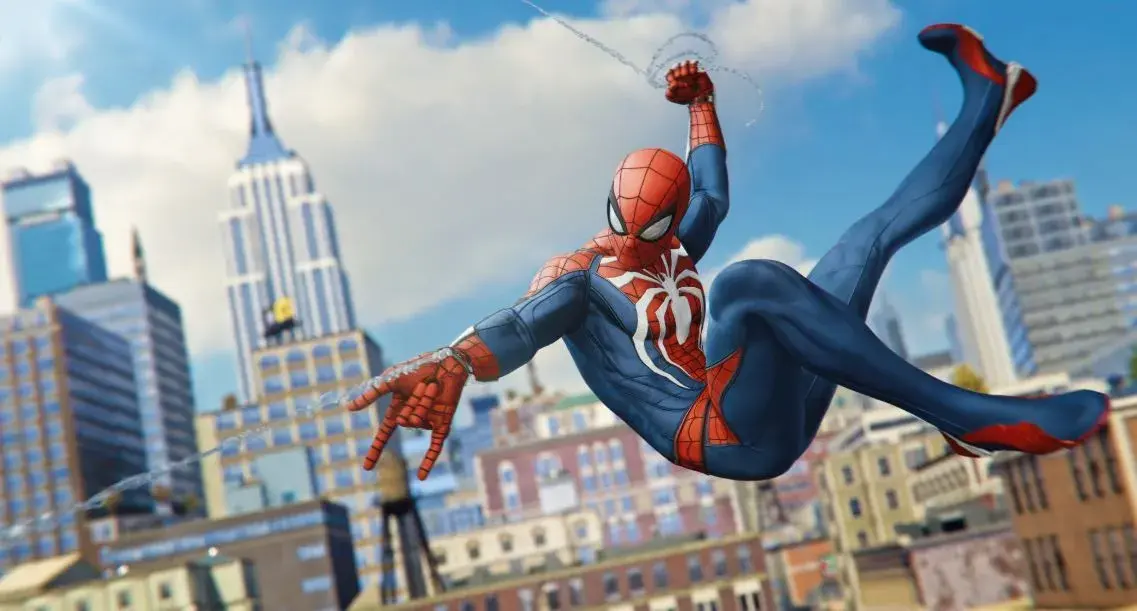
It’s a beautiful experience, provided you have the patience to give the game a few hours to warm up and introduce all the mission types across its gigantic polygonal recreation of New York City—a stunning playground to swing across, packed with icons and objectives to complete. Between side missions, random events (naturally repetitive, though increasingly challenging), collectibles, and more, there’s always something to do. Every task completed outside of the main storyline—which grants experience points used to enhance your own personalized Spider-Man—rewards players with various types of in-game currency. These can be spent at any time to unlock new abilities, alternate suits, and useful upgrades. To access everything, you not only need to complete these activities scattered across the map but also meet specific conditions listed on the left side of the screen, such as defeating enemies in a certain way or performing a move a set number of times. Thankfully, this perhaps excessive layering of systems never interferes with the overall enjoyment of the adventure, even for those who can’t dedicate endless time to it, while offering completionists a wealth of content to dive into.
Ultimately, Marvel’s Spider-Man is far from the first game inspired by Marvel’s web-slinger, but it’s undoubtedly the most polished and respectful adaptation ever made of this legendary pop culture icon. Insomniac has skillfully blended the spirit of Activision’s early-2000s movie tie-ins from the 128-bit era with the design philosophy of Rocksteady’s acclaimed Batman titles. And yes, even though it doesn’t do anything particularly new, I have to admit—it all works wonderfully. So much so that I found myself jumping back in even after finishing the story, eager to swing once again through the rooftops of Hell’s Kitchen in search of crooks to capture.
And if everything I’ve said so far still doesn’t sound convincing enough, it’s worth adding that this new Sony exclusive is among the most visually stunning action games I’ve ever seen on my 4K HDR display. The action runs with near-perfect smoothness (with only rare moments of slowdown) and features incredibly detailed visuals, both during exploration and cinematic cutscenes. Everything is enhanced by expert digital direction that highlights the epic scale of the adventure without compromising performance—save for the occasional bit of pop-in.
The original narrative crafted for Marvel’s Spider-Man is, without a doubt, one of its strongest points. It depicts the everyday life of a superhero far from being a winner in his personal life, constantly trapped by an overwhelming altruism that eventually drives him to make painful choices. While some villains are disposable, it’s clear the writers have laid the groundwork for future installments with an already defined cast. Honestly, I’m just as curious about the future of Insomniac’s Spider-Man now as I once was about Rocksteady’s Batman back when Arkham City launched—and that, truly, is one of the highest compliments I can pay to a video game adaptation of a comic book series.
Marvel’s Spider-Man doesn’t reinvent its genre and owes much of its value (and success) to braver productions that came before it. Yet beyond its lavish production values lies a game that’s deeply enjoyable, impeccably crafted, and capable of entertaining for hours on end without ever growing dull. If you’re a fan of the Spider-Man films, know this: it’s the closest thing to the best Spider-Man movie you’ve ever played.