This article was originally published in Italian on GeekGamer.it in 2018.
You know those video games that get into your brain, make you believe you’re investing your time in something constructive, and force you to stay glued to the screen to ensure all your precious stats stay positive, just so you can be constantly rewarded with triumphant messages?
Well, State of Decay 2 is essentially that: a sequel that feels more like a remake and, all things considered, carries forward all the flaws of the previous chapter. Undead Labs’ title managed to win over no fewer than three million players in just over a month—be it due to its inclusion in Xbox Game Pass or its aggressive launch price—and we at the GeekGamer editorial team couldn’t shirk the thankless task of giving you our honest take.
I’ll admit I personally appreciated much of what the first episode (here’s my review) of this now-established series showed, and I forgave its extreme technical precariousness on console because it was steeped in that typical “indie” production vibe. To my eyes, it looked like one of those many ambitious projects whose wings are clipped by time and budget.
With the team’s acquisition by Microsoft and the IP now effectively exclusive to the Xbox stable, it’s only right to broaden the discussion and look squarely at all the critical issues of a video game that could have been so much more than it is.
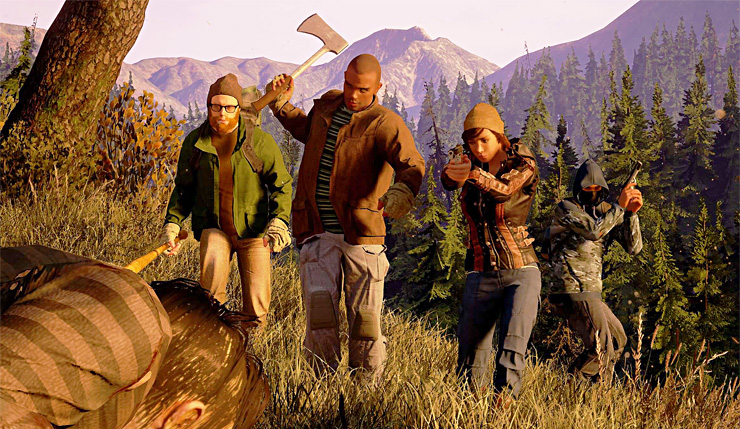
As mentioned, State of Decay 2 is, in every respect, little more than a remake of the appreciable first chapter, featuring significantly larger explorable maps and a few more variations on the “survival” genre. In this game, you are called to step into the shoes not of the usual protagonist with a tragic past, but of an entire group of survivors that you can bolster with new faces and personalities found out in the world. All of this, of course, is guided by randomness. The game does offer starting pairs of heroes with a narrative pretext as their background (and in that sense, it seems lesbianism and zombies increasingly go hand in hand), but don’t be fooled: the death of one or even both starting protagonists does not mean game over. In fact, if there’s one thing this sandbox with micromanagement elements teaches, it’s that nothing is forever—not even a base you’ve spent dozens of hours trying to defend.
Ruled by a procedural algorithm that constantly churns out new tasks (and as always when randomness comes into play, the tasks all end up feeling the same), you must juggle keeping a survivor base afloat, the obsessive push to explore the surrounding territory for food and materials to invest in your community, and the looming threat of a new type of zombie capable of infecting survivors and turning them into man-eaters in short order. All this, needless to say, is managed through screens of numbers and statistics. At first, these mechanics may seem utterly disorienting, but just spend a few hours navigating the menus and you’ll get friendly with what are, in reality, only the lightest of management elements. The game’s core focus remains, as always, diving into the fray against the undead and scavenging as many materials as possible.
So, the basic spirit is the same as the previous episode, enriched by some new elements that, however, don’t really change the cards on the table much. State of Decay 2 presents itself as a decent third-person action title, where the combat system is handled with a single button (or at most a two-button combo for grapples and dodges) and aiming firearms brings back the classic over-the-shoulder camera. Every achievement, mission, and special action—like killing mutated zombies—is rewarded with Influence points, the only major currency in the game, used to modify relations with other survivor groups, barter, and decide whether to occupy surrounding buildings. You can also get around in a decent variety of vehicles, although their physics handling remains rather poor. If you quickly figure out how outposts work and, above all, exploit the fact they can be moved without any real penalty, the challenge level will hardly pose any serious problems.
State of Decay 2 also opens up to communities, both offline and online. On one hand, you can interact with groups of survivors called enclaves who, depending on your relations, can become useful allies, indifferent strangers, or fierce rivals. On the other, the title has finally been blessed with an online cooperative multiplayer mode allowing up to four players to team up to scavenge for materials and wipe out the Blood Plague threat together. Performance here is decent, though as of this writing (and after over a month of updates released almost weekly), getting booted from a session is still a daily occurrence. To curb negative behavior and avoid a toxic community, the game disables friendly fire and lets players loot materials from different spots in the environment, so they don’t “steal” precious loot from each other—items can then be taken back to their own game’s base. If that doesn’t interest you, you can just set the game to offline mode to avoid disturbances, which also grants access to the blessed pause screen, otherwise unavailable. Unsurprisingly, the game doesn’t offer a proper plot, but rather a series of missions that vary depending on the type of leader you put in charge of your survivors, doing away with even the flimsy narrative thread that held the previous game together.
Anyone expecting a The Last of Us vibe from the setting will be set straight immediately, as the horror atmosphere meant to underpin events is flattened by constant lines of dialogue that try, and fail, to give the main characters some color. But considering any one of them could vanish at any moment, it’s pointless to look for a shred of charisma or simple humanity in them: they are effectively just resources, incapable of autonomous behavior or even reacting to the death of a loved one—a detail that might be listed in their background, but that’s it. The characters in State of Decay 2 are, for all intents and purposes, avatars stuffed with skills, a heavy dose of totally uncalled-for irony, and a roster of stats that can be improved. The choice to go all-in on gameplay and strip down the narrative ambitions as much as possible wasn’t taken lightly, and it proves rather wise (especially given the generally poor dialogue, ranging from bad to irritating). It allows you to jump back in even after finishing a campaign in a sort of New Game+, perhaps in a different area, bringing along up to three of your survivors—or you can just roll with a completely random crew. Needless to say, it’s precisely this randomness (especially their innate abilities) that inevitably makes building the perfect base a tad more challenging, though as noted, State of Decay 2 is still a game designed to be accessible (maybe too accessible).
In that regard, the “legacy bonuses” from a previous leader can come to the rescue, granting passive buffs to your camp if you choose. Anyone who played and liked the first game can dive into this new chapter without fear, as the substantial differences aren’t particularly groundbreaking.
The real sore spot in this whole mix of thoughts on a game that’s ultimately solid—but never brilliant—is the technical side. State of Decay 2 is perhaps one of the least “polished” titles among Xbox One exclusives, sacrificing detail on individual assets to deliver on the scale of the world. If that were the only issue, you might even let it slide considering the engine switch (from CryEngine 3 to the ever-popular Unreal Engine 4). But on both Xbox One and Xbox One X, it suffers from a slew of bugs, frame drops (worse on Xbox One X due to the higher resolution), and technical problems—some severe enough to require a full game restart—that I can only recommend, without a second thought, going for the PC version on Windows 10. At least there, despite the same bugs, you can run at a smooth 60fps and enjoy better graphical detail (though supersampling is off the table).
With State of Decay 2, Undead Labs could have—and really should have—realized the dream of a full-blown survival MMO built on the first game’s foundation. What we got instead is more of a reissue, made just interesting enough by a multiplayer mode that lets four players team up. If the final product weren’t mired in a jumble of bugs, the final score might even go up half a point. But in the state it’s in, even after updates and fixes, you have to wonder how it ever won over the hearts—and wallets—of three million people.