This article was originally published in Italian on MyReviews.it in 2016.
Can a JRPG built around an absurd, surreal premise manage to tell a fairly charming story and stay fun without drowning in overused sexual innuendo?
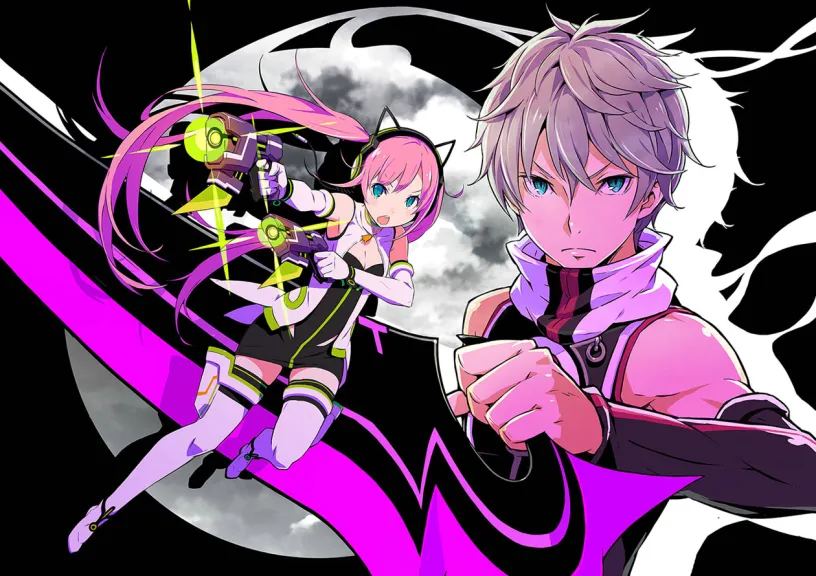
Well, the answer lies in Conception II: Children of the Seven Stars, the sequel to a PSP JRPG that never made it to the West. As the title suggests, the gimmick that makes this hybrid between dungeon crawler and Japanese dating sim stand out revolves around a “conception” system, where the male protagonist forms bonds with several heroines and uses their combined powers to create small “Star Children” — super-deformed humanoids ready to fight against monstrous enemies. It’s a premise that clearly plays into the cheeky tone and romantic slice-of-life storytelling often seen in low-budget JRPGs, yet it manages to work surprisingly well once the controller is in hand, despite a story that’s perhaps too predictable to be truly engaging.
The setup speaks for itself: the protagonist and his stylish companions are young people gifted with powers bestowed upon them by their status as the chosen ones. The divine Star God has selected them for a bright future in the art of war, and it’s up to our otherwise anonymous hero to “conceive” as many Star Children as possible to fulfill his destiny. In practice, this so-called conception ritual is perfectly chaste — the characters simply hold hands and combine their powers to create cute, super-deformed soldier-like offspring — yet the bonds that develop between the protagonist and the various girls in the cast are undeniably one of the game’s key strengths. After all, to produce stronger Star Children, players need to deepen their relationships with their polygonal “waifus,” engaging in a series of unique events not unlike the Social Links seen in Persona 3 and Persona 4 by Atlus.
As one might expect from a game like this, Conception II delivers most of its gameplay through text menus, long visual novel-style conversations with occasional animated sequences to highlight key moments, and 3D graphics used during dungeon exploration — the core of the gameplay loop. Most of the experience revolves around building the “perfect team” to send into procedurally generated labyrinths that separate the protagonist from the end of his journey. Experimenting with different types of Star Children sounds great on paper, but in practice, the game’s overall difficulty is so low that it rarely demands much effort. Fortunately, the social and dating-sim elements fare much better, largely thanks to some decent character writing. Sure, the dialogue and personalities rarely stray from the usual anime tropes and clichés, but the cast is still engaging enough to keep the player invested even after yet another round of turn-based grinding to push the story forward.
From a gameplay perspective, there are at least some interesting ideas — for example, the ability to circle around enemies and strike their weak spots hints at a desire for more depth — but the balancing leans so heavily in the player’s favor that it’s hard to ever feel truly challenged. It’s a shame, really, because with just a bit more effort, Spike Chunsoft could have turned this quirky concept into something much more memorable.
Given its origins on Nintendo 3DS and PlayStation Vita, expectations for the technical side shouldn’t be too high. Still, the colorful art direction and inclusion of the original Japanese voice track — absolutely essential considering the target audience — help Conception II rise slightly above mediocrity. The 60fps performance and modern resolution support are nice touches, but it’s worth remembering that the game was, quite literally, “conceived” (pun intended, sorry!) for handheld systems, which naturally means it was designed for much smaller screens than the average gaming monitor. Not that it needs to be said.
Conception II: Children of the Seven Stars is an unusual title with a premise as bizarre as it is intriguing, though one that ultimately struggles to deliver once the action begins. Its simplistic JRPG mechanics never quite shine, while the strategic layer of team-building is overshadowed by the far more prominent (and arguably more entertaining) dating-sim component. That side of the game, at least, benefits from attractive character designs and polished high-resolution artwork. In the end, it’s clear that Spike Chunsoft decided to prioritize the waifus.