This article was originally published in Italian on GeekGamer.it in 2016.
Max Payne and Alan Wake weren’t enough. Remedy Entertainment rides the wave again with a brand-new, sci-fi-tinted project. In Quantum Break, the brazen, flirty winks at TV-series-style storytelling are shameless; a solution already sketched out in the past with the Stephen King-esque video game, where the main story chapters were sandwiched between an opening title sequence and end credits, complete with fake credits and a brief “previously on…” recap.
With the backing of Microsoft Studios and their bottomless finances, the fathers of Max Payne were clearly able to rely on sky-high production values. The assurance, once again, is the obvious writing talent of Sam Lake and his merry crew, proven in the past on Xbox 360—where, unfortunately, Alan Wake was never rewarded by the masses or with fat profits.
Let me say this right away: if it weren’t for the solid quality of the screenplay and virtual direction, Quantum Break would probably lose a good chunk of its appeal. In fact, the epic penned by Sam Lake, lead writer on the Max Payne and Alan Wake series, works so well it never bored me, even when dealing with themes I’m not particularly fond of, entertaining me in a way even the excellent writing of Naughty Dog’s Uncharted series never quite managed in the past. The credit certainly doesn’t lie in the themes tackled or the supposed originality of the plot—all things we’ve seen in years and years of cinema and British TV or Joss Whedon-ian memory—but in the fine characterization of the protagonists and (above all) the antagonists. In the Remedy title, the thin veil of smoke separating the former from the latter is so imperceptible it makes the motivations driving each of their steps believable, fostering an empathy-building process with the player (or viewer). If in the game Jack Joyce is painted as a sort of improvised hero, the TV mini-series explores the motivations and thoughts of Paul Serene and his henchmen, telling a full 360° story that, while not free of plot holes and a few inconsistencies, manages to be compelling and well-told.
Clearly, Quantum Break also benefits from the generally poor average quality of writing in action video games, and I certainly wouldn’t be surprised if for a while, Microsoft Studios’ latest offspring is spoken of as a good example to follow in that regard.
The plot is dead simple: Jack Joyce (played by Canadian actor Shawn Ashmore) gets caught up in an experiment created by his brother (Dominic Monaghan) and Paul Serene (Aidan Gillen), an old friend he hasn’t seen in years. This tragic event not only kicks off the narrated events in the game, but causes a rupture in the flow of time (yes, you read that right), granting Paul and Jack superhuman powers. Naturally, the two find themselves on opposite sides of the affair and will confront each other for the entire adventure in search of an ideal solution to “repair” the mechanisms that move the hands of clocks. Amid Chinese box puzzles, conspiracies, betrayals, and a few unexpected twists, the title’s narrative is enriched by many textual documents scattered in the explorable environments and by a TV series of 4 episodes at 22 minutes each, introducing secondary characters and narrative lines parallel to the main one. Unfortunately, the much-touted ability to alter the story’s course remains one of the video game industry’s many empty promises, and although the live-action adaptation materializes some juicy differences in the final part, the developers’ intended fate for Jack Joyce is fundamentally fixed and cannot be derailed from the already-written tracks. No big deal: the final result is so enjoyable it makes you want to step back into the young hero’s shoes even after the main story concludes, perhaps to discover the results of a different choice from the one made during the first walkthrough. Come to think of it, among the things I liked about Quantum Break is also its length: neither too long nor too short. A quick sprint through a story that didn’t need tens and tens of hours to be told, the Remedy title can easily be finished in 6-8 hours even on the highest difficulty level. And before anyone points an outraged finger at the number, let’s remember this is a heavily story-driven action game. It’s. Fine. As it is.
The gameplay of Quantum Break is undoubtedly the most controversial aspect of the production. All things considered, it configures itself as a TPS with cover mechanics, a genre widely popularized by the Gears of War series and traversed in recent years by dozens of franchises, like the aforementioned Uncharted from Naughty Dog, the first Tomb Raider by Crystal Dynamics, or the much-celebrated The Last of Us. In Quantum Break, however, the linearity of the level design is subservient to a management of game mechanics that doesn’t involve the player advancing from cover to cover, but constant evasive movement across the battlefield thanks to the protagonist’s powers. He can indeed alter space-time around him, moving at hyper-sonic speed, generate time shields, remote explosions, and other goodies introduced as the story progresses or when an ability becomes necessary to escape a particular situation unscathed. Precisely for this reason, interaction with walls and protective surfaces isn’t even handled by a button but is automated, dedicating the action on the joypad solely to the good use of the protagonist’s powers—who, get this, proves incapable of responding to enemy physical attacks with a simple punch.
A certainly courageous approach that in some way makes Quantum Break unique, but one that could discourage veterans of the genre and prove disorienting, especially given the adoption of forced gameplay conventions typical of similar titles. One example among many is that you often can’t proceed through levels unless you’ve cleared all enemies in the area like in any arena shooter, even when they’re quite far away and therefore not very interested in hurting the protagonist. Further weighing on the purely ludic aspect are several rather important factors, like the scant variety of enemies (there are 3-4 types, all with the same action patterns and minimal differences) and weapons available, the absence or near-absence of environmental puzzles making good use of the protagonist’s powers, and an imbalance in difficulty that especially affects the final confrontation. There, brainless spamming of the protagonist’s superhuman abilities isn’t just suggested or strongly recommended, but practically mandatory. And if the only way the game has to raise the challenge level is to throw an increasing number of identical enemies at the player, perhaps there’s a foundational problem.
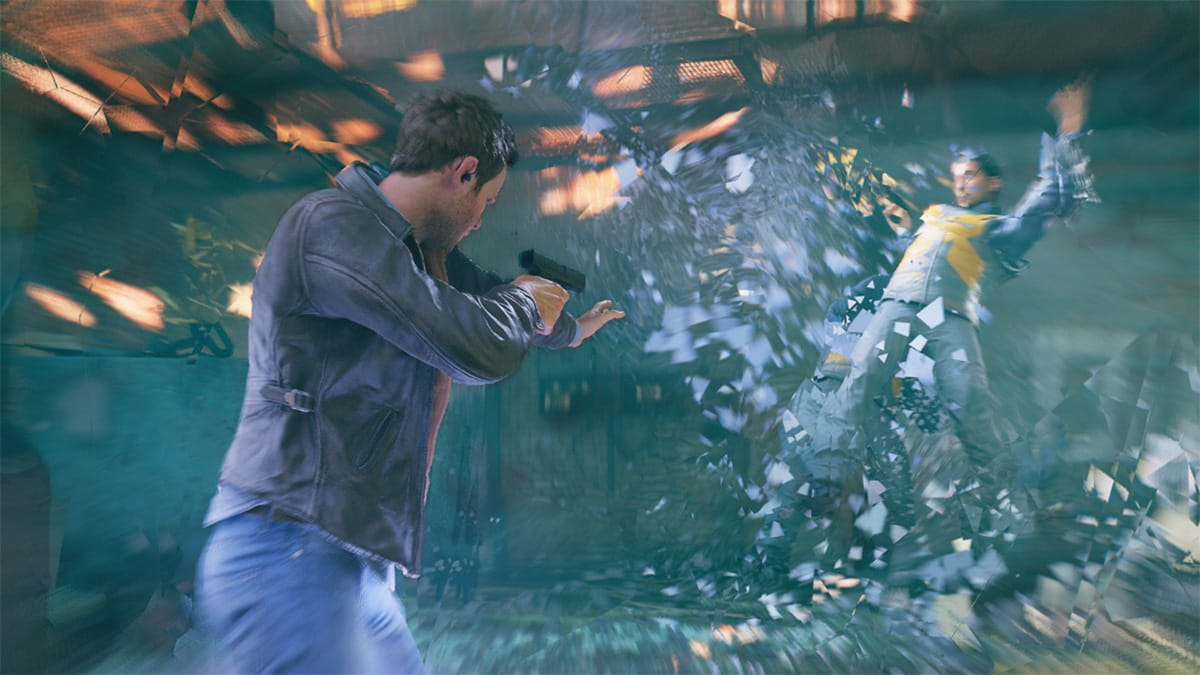
For months, there was talk of how Quantum Break squeezed the Xbox One hardware dry, and that’s actually true: to this day, I don’t recall ever seeing something this impressive running on the Microsoft console. The modeling of environments and protagonists is simply incredible, even outside the customary cinematic scenes. The graphical effects that distort and “dirty” space when the protagonist’s powers manifest are undoubtedly impressive and, considering the sum of the individual elements, I want to decree excellence—without any possibility of contradiction—for the entire technical compartment of the production. Clearly, the PC version, exclusive to Windows 10, will prove even better, hitting 4K resolutions (the Xbox One version uses a rather original solution) and benefiting from all the technical perks normally only the fortunate “master race” of gaming can boast—including full compatibility with DirectX 12. But it’s pointless to deny it: even on Xbox One, the game makes its damn fine impression. For once, I also found the Italian dubbing to be quite classy, despite being plagued by the usual cast of voices found in any video game published in the last decade or so; on this occasion, Microsoft’s efforts ensured the TV series was also dubbed in the language of Dante, guaranteeing players the chance to enjoy the entire Remedy work in Italian. Good job, Microsoft!
Quantum Break seems like one of those ideas Joss Whedon would tell by putting a beautiful girl with mysterious powers as the protagonist. It’s an action game that isn’t particularly thrilling, perpetually indebted to a competent narrative department and enhanced by a budget that, whether we like it or not, elevates its appeal. The interesting experiment bridging the world of TV series and video games is the fruit of production values that only Microsoft Studios could assure Remedy Entertainment, especially after the latter failed to make its previous IP as popular as it would have liked (and, believe me, Quantum Break is stuffed with Easter eggs dedicated to Alan Wake—you can tell they really care about the tormented writer). Whether this makes the latest game from the creators of Max Payne an unmissable adventure will be decided solely by personal taste. What I can assure you is that behind the evident limits in game design hides an ultimately fun product, certainly not revolutionary, but endowed with an authorial flair that only Remedy’s storytellers—and a few others—can afford.