This article merges two articles previously published in Italian on IGN Italy.
After the commercial success achieved by the two Atelier games starring the well-endowed Ryza, Gust and Koei Tecmo return to focus on one of the series’ previous heroines — part of a long-running JRPG saga centered on young alchemists.
For years, the franchise’s production team adhered to a self-imposed canon: creating trilogies of games, each with its own narrative universe and distinct artistic direction. That convention was only broken in 2019, when Atelier Lulua: The Scion of Arland — the fourth installment set in the kingdom of Arland — was unveiled, featuring Lulua on the cover, the daughter of young Rorona, the beloved protagonist of one of the series’ most cherished episodes and of the much-loved, nostalgia-inducing “Arland trilogy.”
That move clearly revealed Gust and Koei Tecmo’s intention to revisit the worlds of their best-selling entries, celebrating their legacy and drawing once again on the charm of their most memorable characters. In the case of Atelier Lulua, the idea was straightforward: continue the events of the previous trilogy with a brand-new, conclusive fourth chapter — a perfect opportunity, given its place in the timeline, to reunite much of the cast seen throughout the Arland saga.
The next title to hit the market, Atelier Sophie 2: The Alchemist of the Mysterious Dream, is an even more intriguing experiment. It’s presented as a direct sequel to Atelier Sophie (2015) and at the same time as an interquel that fits—somewhat awkwardly—within the continuity of an already-complete trilogy, which includes Atelier Firis (2016) and Atelier Lydie & Suelle (2017). In short, it’s a “new” second chapter within what had until now been conceived as a three-part epic. Yet Atelier Sophie 2 doesn’t hesitate to sweep aside the characters and events of the later Mysterious entries. A coincidence? Hardly. It’s worth remembering that both Atelier Firis and Atelier Lydie & Suelle were commercial and creative missteps — a conclusion I also reached in my review of the Atelier Mysterious Trilogy Deluxe Pack, which bundled all three installments.
It’s easy, then, to imagine that with Atelier Sophie 2 the creatives at Gust wanted to give a second chance to a heroine who had been unjustly overlooked — one whose personal journey was followed by titles more interested in gameplay experimentation than in emphasizing what the series has always done best: telling lighthearted stories filled with memorable characters, charming and colorful worlds to explore at a leisurely pace, and deep crafting systems to lose oneself in for hours.
And indeed, Atelier Sophie 2 begins precisely from those elements, which take center stage from the very first scenes. We find an enthusiastic Sophie, joined by her loyal friend and companion Plachta, setting out from the gates of Kirchen Bell — Sophie’s hometown — on a journey that soon leads them into a magical forest. There, the two encounter a colossal tree seemingly plucked from the pages of a fairy tale, only to be swept away by a mysterious vortex that separates them and transports Sophie to Erde Wiege, a parallel world where time stands still — and among its inhabitants lurk familiar faces, though in entirely new forms.
Drawing on the increasingly popular isekai literary genre, Atelier Sophie 2 plays it safe by setting its events in a world parallel to the original trilogy’s continuity — a convenient way to avoid inconsistencies while granting complete freedom for a self-contained adventure. Sophie’s goal? As you might guess: to find her friend and return home to those waiting for her with open arms.
Atelier Sophie 2: The Alchemist of the Mysterious Dream serves both as a reflection on the Mysterious trilogy (2015–2017) and as a worthy new entry in the Atelier saga.
Developed to celebrate the franchise’s 25th anniversary, this new JRPG highlights the series’ most beloved qualities: charming alchemists, slice-of-life storytelling, and an emphasis on warm, human moments. If not for its peculiar status as an “apocryphal” chapter—its story unfolds between Atelier Sophie and Atelier Firis—one could almost hope it might mark the beginning of a new trilogy.
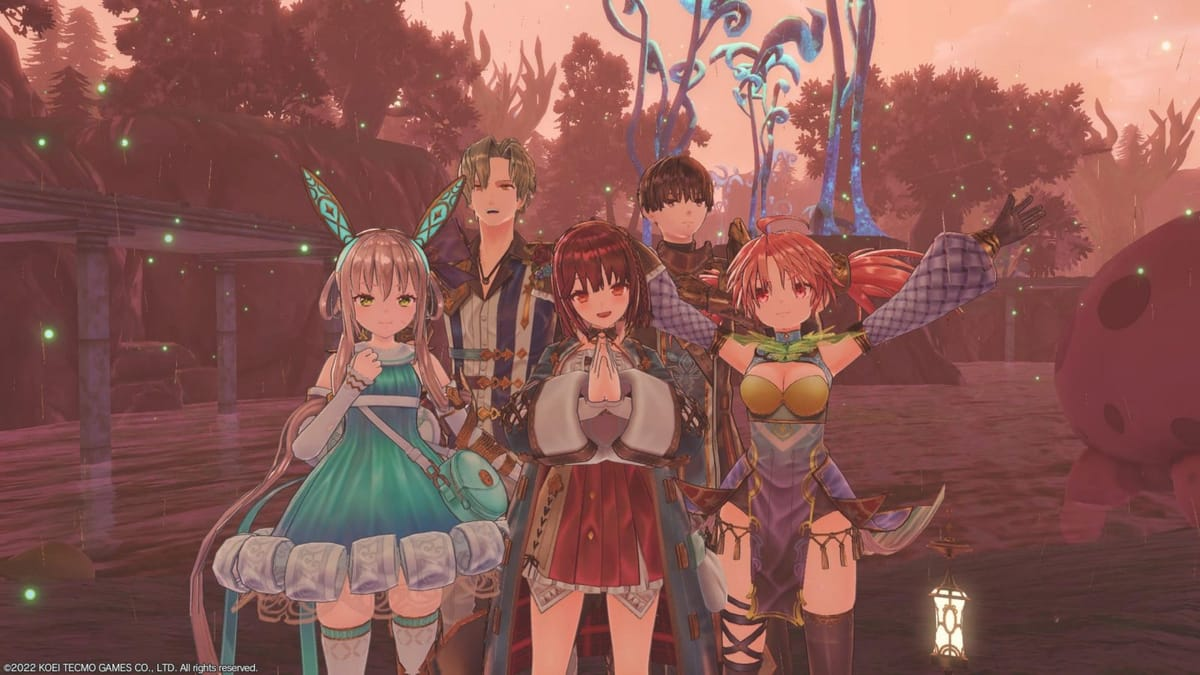
Once again, players step into the shoes of the young and determined Sophie, accompanied by her mentor Plachta, a legendary alchemist trapped in the body of a doll. During one of their many adventures, the pair come across a massive tree that seems to stir Plachta’s memories. Before we even have time to admire the game’s improved visuals, they are drawn into a parallel dimension — Erde Wiege — a timeless world where people from different eras coexist peacefully, free from aging, and focused solely on realizing their life’s dream. There, Sophie meets a colorful cast of characters, including a younger, inexperienced version of Plachta and none other than her beloved grandmother — here reimagined as a lively adventurer in her prime.
The story of Atelier Sophie 2, true to the series’ traditions, doesn’t aim for thematic depth. Instead, it’s the characters and their slices of everyday life that take center stage. The narrative revolves around a single concept: the importance of dreams, and how the passage of time—through failure and uncertainty—can sometimes make us lose sight of them. All this is delivered with Gust’s trademark syrupy storytelling, which may not appeal to those seeking a more conventional JRPG experience. That said, the writing deserves credit: while the characters fit recognizable archetypes, the story is well-paced and charmingly told, with some genuinely touching moments toward the finale, including surprisingly emotional twists.
Beyond the narrative, Atelier Sophie 2 benefits greatly from the experience Gust gained with Atelier Ryza 2 and Blue Reflection: Second Light. There’s a clear sense of “readjustment” with each new project, as if the team is steadily refining its formula. And this time, that effort pays off. The game revisits what made the Mysterious trilogy stand out — its crafting and turn-based combat systems — and integrates them into a more agile, visually appealing framework without falling into excessive experimentation (thankfully, there are no clumsy “open-world” attempts like in Atelier Firis).
The improvements made in Atelier Ryza and its sequel are evident here, especially in the larger, more detailed environments. Between cliffs, platforms, and narrow passages, it’s clear that a return to the series’ older, flat maps would be a step backward. Gust goes further, introducing simple environmental puzzles based on weather manipulation: players can alter the climate to access new areas, uncover hidden paths, and reveal secrets that might require revisiting earlier zones later in the game.
Weather even plays a role in boss battles, which — as in the Mysterious series — are turn-based. Changing the weather can alter the battlefield and give players tactical advantages. However, only the toughest enemies offer real challenge, since the overall difficulty is rather low (I reached the level cap halfway through the story), and the six-character battle system feels familiar. As always, alchemy remains key: mastery of crafting determines both combat efficiency and progression speed, showcasing once again why this system is the heart of the Atelier experience.
Crafting in Atelier Sophie 2 returns to the familiar Mysterious formula. Recipes are discovered through exploration, alchemical synthesis, or defeating specific enemies, and the process takes the form of a colorful puzzle grid. Each crafted item varies by quality and traits, ensuring plenty of room for experimentation.
As always, breaking the game’s balance comes down to one’s skill at the cauldron: with enough knowledge, it’s possible to craft “perfect” versions of low-tier equipment and challenge endgame foes far ahead of time. This experimentation is further encouraged by the adventurer’s guild, which rewards players for hunting certain monsters, collecting specific materials, or crafting items with particular traits or quality levels.
Overall, with new gathering mini-games that influence ingredient quality, Gust finally seems to have found the sweet spot: a crafting system that’s deep and satisfying without feeling tedious or overwhelming. The only drawback is the near-total lack of challenge. The Atelier series long ago abandoned its dreaded time limits (anyone who played Atelier Rorona on PS3 knows what I mean) in favor of greater freedom — but a touch more difficulty would have added tension, especially given the complexity of the alchemy system and the introduction of catalysts in the latter half of the adventure.
Visually, Atelier Sophie 2 marks another step forward for Gust. Despite the usual limitations — minimal animations, a small variety of monsters, mostly static cutscenes — the presentation is charming, thanks to strong cel-shading, solid art direction, distinctive character design, and a lovely soundtrack. The environments finally feel more cohesive with the character models, long the highlight of the series. It’s all enjoyable enough, though it’s clear this remains a mid-budget production, far from the scale of titles like Tales of Arise or any Final Fantasy. Unless Koei Tecmo decides to invest in the franchise at the level of Atelier Ryza, these technical constraints will likely persist.
Still, the overall experience is polished and accessible, thanks to numerous quality-of-life improvements: fast travel available from the start, battle animations that can be sped up at will, and teleport points scattered throughout the maps all contribute to a brisk, modern pace. And yes, once again there’s no Italian localization — but at least the Japanese voice acting is excellent, and there are plenty of post-game extras, including tougher bosses for those who see the story through. It may not be the grand 25th-anniversary game some fans were hoping for, but Sophie’s return couldn’t have been handled much better.
Atelier Sophie 2: The Alchemist of the Mysterious Dream celebrates its heroine by giving her a new, heartfelt adventure alongside her beloved Plachta — and it’s also clear proof that Gust has learned from its past missteps with the Mysterious trilogy. It doesn’t reinvent the formula, but instead polishes and refines what fans have always loved about the series. If Atelier games never clicked with you before, this “what-if” sequel probably won’t change your mind — but for everyone else, it’s a lighthearted, colorful, and stress-free journey well worth taking.