This article was originally published in Italian on GeekGamer.it in 2017.
“Enter the Survival Horror” solemnly reads the tagline of the Resident Evil remake that has just arrived on PlayStation 4, PC, and Xbox One, after having terrified GameCube owners for years. There is only one reason: Capcom knows it arrived first in a genre that, up until 1996, was represented only by the very rough Alone in the Dark, of which Resident Evil (or Biohazard in Japan) was merely a reinterpretation served to the console audience. To talk about the evolution of the series, nothing is better than the remake of the first episode: it represents the qualitative peak of the first generation of horror titles made by Capcom. After playing Resident Evil Rebirth (as we liked to call it before the remastered version), there will no longer be any way to remain amazed by the old 32-bit iterations or their more or less declared clones, like Dino Crisis and Parasite Eve 2. From there, it was Resident Evil 4, a bolt from the blue that subverted the pondered and thoroughly digested logic of survival horror with fixed cameras and pre-rendered backgrounds: the same universe of dragging footsteps and zombie moans was grafted onto an agile, modern gameplay structure, capable of injecting new adrenaline into those plots whose claustrophobic tension appeared more represented on screen than ever truly felt.
Resident Evil 4, with its iconic Leon Kennedy, marks the beginning of Capcom’s second generation of survival horror and is one of the best-selling video games of all time, so much so that it was converted for mobile phones and obscure consoles, eventually arriving on PlayStation 4, PC, and Xbox One in a brilliant HD version. The departure from Capcom of Shinji Mikami and Hideaki Kamiya, creators and directors of the franchise’s most beloved chapters, somehow ended up influencing the direction in which they were now moving: a dimension characterized by cooperative online play (after the failure of the highly promising Resident Evil Outbreak), purely TPS action, and an aesthetic positioned halfway between the exaggerated explosions of the film adaptation and the charm of American superhero comics. This drift culminated with Resident Evil 6, a video game that tried to please everyone by offering three full campaigns (plus an extra one) permeated by distant and often irreconcilable atmospheres.
Despite sales ultimately vindicating Capcom, the sixth episode remains for many a veritable failure and became for many proof that the software house lacked the courage to choose a precise direction for one of its flagship series. And if today there are so many spin-offs reinterpreting the individual components that made Resident Evil famous (the horrific atmosphere in Resident Evil Revelations, the multiplayer action in Operation Raccoon City and Umbrella Corps), perhaps this is precisely the reason: it’s time to decide what to be when we grow up.
Resident Evil 7: biohazard (in Japan Biohazard 7: resident evil, a nice touch!) represents a solution that is radical in many aspects, elaborated with stubbornness even at the cost of alienating those who fell in love with the Capcom series at its dawn, and those who approached it during the action evolution of the second generation: in short, it is a veritable “clean slate.” It is right to immediately dispel two preconceptions, harbingers of many misunderstandings about this product: it is neither the first chapter to choose a first-person perspective, nor does it represent a total upheaval of the traditional formula. You only need to play it for a few minutes to realize that everything on screen oozes nostalgia from every polygon. Thankfully, it’s not a bland capitalization on memory, one of those operations where said nostalgia represents the only real attraction. Rather, I would compare it to that feeling you get when returning home after a long time following renovation work, when you enjoy the modernization of a structure that remains familiar nonetheless.
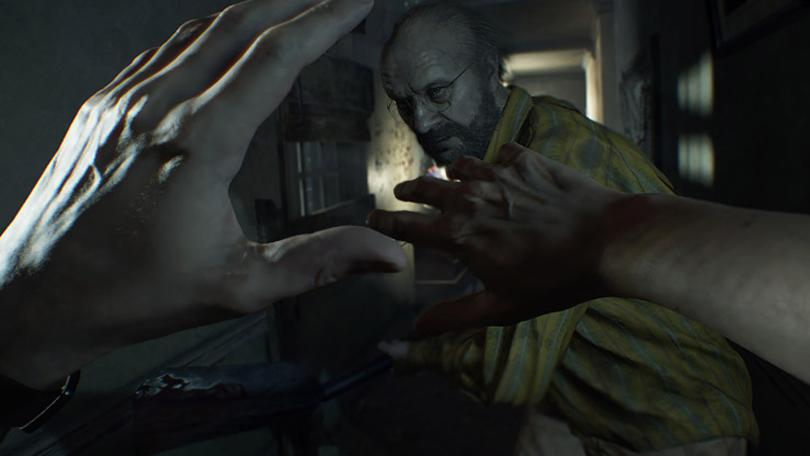
The protagonist of this VR-friendly adventure (and the first and—so far—only high-budget project dedicated to virtual reality) is Ethan, a man about whom we need to know nothing except his romantic relationship with Mia, a woman presumed missing but who then suddenly reappears under wholly mysterious circumstances. This simple pretext forces us to take our first steps on the muddy soil surrounding the Baker family estate, a group of disturbing schizoids seemingly intent on killing our avatar, understandably reluctant to join their “family.” The story is penned by Richard Pearsey, the first gaijin to lay hands on the series’ narrative department and already appreciated as a screenwriter for video games celebrated precisely for their plot, such as Spec Ops: The Line and F.E.A.R. (for which he handled some additional content). And even if it’s true that the similarities with F.E.A.R. are many, Resident Evil 7 still manages to subsume the best from this and many other external inspirations, overt or not, without ever renouncing its own solid identity.
There’s certainly a bit of The Blair Witch Project, a pinch of The Texas Chainsaw Massacre, and some (to use a euphemism) influence from the horrific and surreal cinema of Raimi and the young Peter Jackson within the Capcom title: but the backbone of all these influences and inspirations remains the gameplay skeleton, and an atmosphere that finds its foundation in the exploration of a closed and unsettling setting. Resident Evil 7 recreates that sense of tension and claustrophobia that only fixed cameras and good use of in-game direction managed to give to the franchise’s first episodes, while simultaneously embracing all the (useful) modern gameplay conventions like checkpoints and avoiding elements that might somehow create “distance” between the player and the world they move in. On-screen indicators reduced to the bone, a practically absent HUD, quick time events completely forgotten, and here you truly find yourself there, in the front row, facing the horror of a dramatic, bloody, and, why not, sometimes tasteless story, but also one capable of prompting some mild reflection by the final lines without indulging in useless sentimentality and lengthy cinematics. Of course, at times one isn’t entirely convinced by the script’s sudden shifts in tone, but at the end of the day I can state without many problems that I am faced with one of the best chapters (if not THE best) in terms of the purely narrative aspect.
Capcom’s latest work can be roughly divided into a first part where exploration and simple puzzle-solving sessions dominate; and a second phase where proceeding through the corridors is marked by a decidedly less impactful FPS component, but supported by good level design of the locations, never too labyrinthine, and an unpredictable action pace, capable of sustaining the entire duration of the story without becoming boring or feeling “excessive.” The exploratory phases are characterized by settings recreated with great abundance of details, moreover largely interactive and not displayed as mere aesthetic ornamentation. Treading the cold parquet of a recently unlocked room and noticing it’s packed with furniture with drawers and doors to loot has never been so comforting.
In contrast, the clashes in the second phase of the adventure are limited by the extremely scant variety of enemies, who are moreover “approachable” in very similar ways and easily circumvented by exploiting the doors separating each room from the other. A convention that could work in the ’90s, but which in this incarnation of the game inexorably shatters the suspension of disbelief when one observes that simply crossing the threshold of a save room causes enemies to suddenly lose interest.
The survival component, however, is all in all the one the series had accustomed us to so many years ago, with limited inventories, items to combine, and others to examine to discover their use. A series of callbacks that is absolutely appreciable, given the (apparent) scarce relation between Ethan’s misadventures and that world on the brink of apocalypse told in Resident Evil 6, of which, I want to remind you, this seventh chapter is a veritable canonical sequel. In a mix of new and old, classic and modern, citationism and homage, Resident Evil 7: biohazard appeared to me as a good compromise between what could have been a simple chase of the commercial trend (namely the shameless imitation of the formula of hugely successful horror titles like Amnesia or Outlast) and a more framed return to origins. For that, after all, there will be the already announced Resident Evil 2 remake along the lines of what was seen in Resident Evil HD. And let’s not forget that this is a video game playable from start to finish while wearing Sony’s virtual reality headset, a component less trivial and secondary than it might seem. And mind you: it’s not a “redux” or dedicated mode, as with DriveClub or Rise of the Tomb Raider, but the same single-player campaign you can comfortably play in the classic way. But projected for real into the Baker estate. In a word: a waking nightmare, as well as one of the most terrifying—and at the same time astonishing—experiences I’ve ever had in almost thirty years of passion for video gaming.
And if everything flows, without uncertainty, at the now indispensable threshold of 60 frames per second (if we don’t account for occasional drops in fluidity on Xbox One), we owe it also to the new graphics engine that will have to support the future of the series: the self-referential RE Engine. Resident Evil 7: biohazard shows its best on PlayStation 4 Pro, where the image enjoys a clarity practically indistinguishable from the obvious technical supremacy of the PC incarnation. The fortunate inclusion of the title in the Xbox Play Anywhere program translates into a single digital purchase valid for both the Microsoft console and Windows 10 via the Windows Store, with cross-save and shared achievements. As mentioned earlier, Resident Evil 7 is to date the only major high-budget title available for Sony’s virtual reality (it will be made compatible with PC headsets only in a year, according to Capcom) and, I can assure you, there is nothing comparable to wandering around the Baker estate and surrounding areas wearing the blue LED helmet of PlayStation VR. One word: impressive.
With a clean sweep, Resident Evil 7: biohazard erases the recent turbulent past of the Capcom IP, inaugurating what could be a very interesting third generation of Japanese survival horror. A finally appreciable narrative line (however stylistically clashing) and a good blend of old and new are the highlights of a product that did not want to compromise with the historical identity of the franchise, embracing its essence and re-elaborating it according to an aesthetic in step with the times and, moreover, interesting. Which, given today’s video game landscape, can only be surprising.


[…] being one of my favorite titles of the now-concluded year and one of the best experiences you can have wearing PlayStation’s […]